

The Idea
The sun was out when we set off. It was warm enough that our beanies and windbreakers had stayed packed inside our backpacks.
We’d come to Aoraki/Mount Cook National Park to walk the Hooker Valley track. But it had been closed for repairs when we got there.
The Sealy Tarns track, however, was still open. Lovingly nicknamed the Stairway To Heaven, it was a six-hundred-metre climb, around 2,200 steps, and about two hours to the top.
It was a hard track. But we were up for it, so we decided to take the stairway and see what heaven had to offer.
“Easy, let’s go,” My husband said,
We got started.
It didn’t feel too bad at first, mostly because the path began flat. But then it started to incline, finally revealing the infamous stairs.
They were heavy timber blocks and old railway sleepers, zigzagging up the mountainside, with stone and bare earth packed in between. Some were shallow. Some needed a high knee lift. And once the climbing started, there was no let-up, no flat ground, and no trees for shade.
We didn’t stop much for the first part, except to take photos of the river braiding itself across the valley floor, and the peaks with snow caught in their creases.
The higher we went, the cooler it got. Even with the sun on us.
Beanie on.
Jacket zipped.
Hood up.
The steps were relentless now.
My legs had started to burn, I was struggling to catch my breath, and I had begun pacing myself to reach the end of each zigzag before stopping.
Every time I looked up there seemed to be a never-ending set of stairs above the ones I had already climbed.
Why did we choose to do this?
People coming back down passed us one after another.
“Keep going. You’ve got this.”
“You’re close,” one of them said.
We thanked them, and realised we weren’t close at all when another person said the same thing ten minutes later.
We kept climbing anyway. Another twenty minutes passed. Then another twenty.
We were almost at the ridge when we stopped again.
“Look at that!” My husband was smiling and pointing at the sky.
I turned around to see what he was staring at.
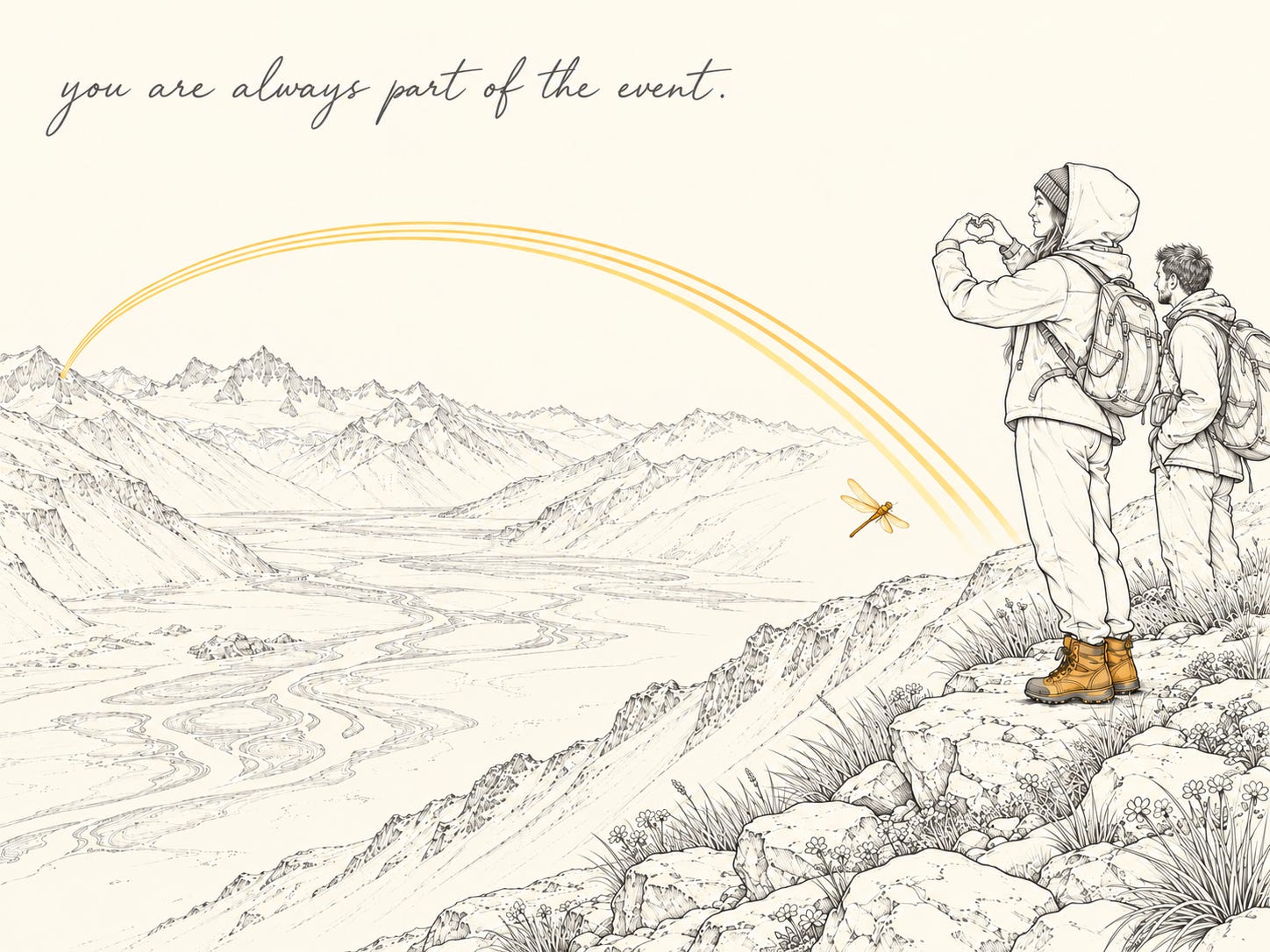
And there right below us was a beautiful stretching rainbow. A burst of colour smiling over the valley beneath.
“Oh wow.” I said in awe.
We stood there side by side, sharing the moment.
But could two people ever see exactly the same rainbow?
Still reading? Subscribe for more free posts - one thoughtful five-minute read, once a week.
The Science
Rainbows have no fixed place in the sky. They only exist in relation to the person looking at them.
Every rainbow is made by millions of raindrops. When sunlight enters a drop, it bends, bounces off the back of the drop, and bends again on the way out.
Now although sunlight looks white, it’s actually every colour mixed together, and each colour bends by a slightly different amount. So by the time the light leaves the drop, the colours have been pulled apart. And the rain bows.
In 1637, the philosopher René Descartes worked out that this coloured light left each drop at particular angles - about 42 degrees for red, down to about 40 degrees for violet.
Those angles are the key to everything you see. There might be millions of raindrops in front of you, but only the ones at exactly the right angle send their colours straight into your eyes. Those are the drops you see as a rainbow.
And because the light bounces back out of the drop, you need the sun behind you to catch it. Which is why a rainbow always appears on the opposite side of the sky from the sun, and why we didn't see ours until we turned around.
Then there’s the most surprising part (stay with me here).
Picture an ice-cream cone with its tip touching your eye, opening out into the rain. Every raindrop sits at an angle on the rim of the cone. That rim is the rainbow. It's actually a full circle, but from the ground, the earth gets in the way of the bottom of it, so we usually see an arc.
So because the cone starts at your eye, it moves when you move. Take one step to the side and its rim passes through a different set of raindrops. You still see a rainbow in almost exactly the same place, but it is made by new drops.
Which means my husband was seeing a totally different rainbow to me, even though I was standing only a step away from him. His rainbow was made from different raindrops from mine.
Where It Shows Up
When you’re watering the garden on a sunny afternoon, with the sun behind you. A small rainbow appears in the spray. Take a step to the left, and it moves with you. Ask someone to stand beside you and they see one too.
When you're at the beach watching the sun come up over the ocean. A strip of sparkling light stretches across the water, from the sun straight to your feet. The person twenty metres down the beach sees a strip of light too, but theirs leads straight to them.
After a storm, when the sun comes back out, the wet road ahead of you suddenly flashes bright like a mirror. Walk a few metres and the bright patch moves with you.
The Subtextt
Beneath the feeling of seeing a rainbow on a mountain was the realisation that I wasn’t separate from what I was looking at.
The rainbow appeared because of the relationship between the sunlight, the raindrops, and where I was standing.
Similarly, we often think that life is something that happens outside of us, that we sit back and observe it. But standing there on the mountain revealed a simple truth - that even when we are looking at something like a view, we are actually a part of what is happening.
Depending on our position, we can change what we see. We can change what we notice, whilst the world around us affects us at the same time.
Experience then is not something that happens in front of us. But something that happens within us and with the world we are moving through.
It’s about how you receive it too!