

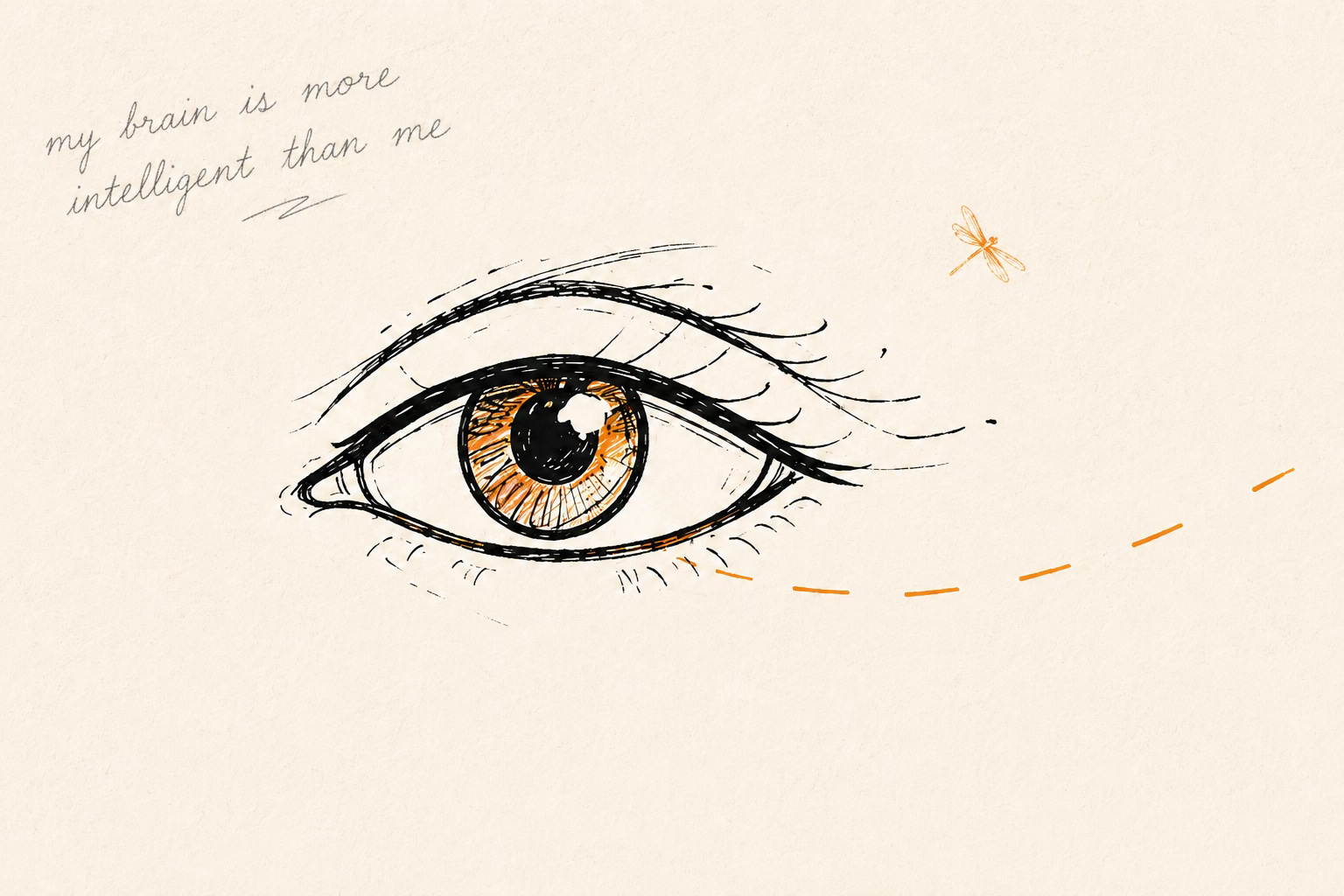
The Idea
It’s a bit odd when you stop and think about it. We go about our lives assuming we’re seeing everything as it is, that what’s in front of us is what’s really there. The more I sat with that idea, the crazier it seemed. What if we’re not actually seeing the world as it is? What if what we see has already been shaped for us?
It turns out, it has.
The Science
Your brain is an expert editor. Every day it trims the shaky moments and smooths out the glitches so you never notice them. Reality, as you experience it, is polished and seamless - because your brain insists on it.
Your eyes are constantly darting around, making tiny jumps called saccades three or four times every second. During each jump, your brain briefly shuts off the incoming visual signal, a trick called saccadic masking. Each blackout lasts only a fraction of a second. But add them all up across a day and it amounts to roughly 40 minutes of visual information that you never get to see.
This means the world you experience isn’t exactly what’s out there. It’s the version your mind has chosen for you.
Try It Out
Look in the mirror and shift your eyes quickly from one side to the other. You’ll see your eyes jump between positions, but you won’t see the movement itself. The edit is invisible, even though you’re looking for it.
You’ve seen this same trick applied elsewhere. It’s exactly what your phone does when it stabilises a shaky video, smoothing in motion in real time so the result feels steady. Your brain has been doing this naturally, constantly, your entire life. a
By the time you go to bed tonight, it will have quietly erased the equivalent of about 40 minutes of blurry, unstable footage.
Why Your Brain Does It
Without this editing, the constant motion of your eyes would make you dizzy, disoriented, and nauseous. Saccadic masking is your brain’s built-in stabiliser, choosing your comfort over completeness, every second of every day.
Where It Shows Up
Scientists are beginning to work out how to read the brains raw footage before the edits kick in. Early experiments by Jack Gallant showed that by scanning brain activity while someone watches images, you can reconstruct a rough version of what they are seeing - it’s blurry, but recognisable.
More recent work using AI has pushed this further, with researchers able to match brain activity to the exact image a person was looking at.
The goal isn’t purely curiosity. It could help eventually help people who can’t communicate verbally, or give us a much deeper understanding of how perception works. But even most advanced reconstructions aren’t capturing raw reality yet.
The Subtextt
Beneath the pressure to understand everything is the simple truth that you were never designed to. We live in a world that constantly demands more information, more clarity, more understanding. But the brain disagrees. It edits, removes, and simplifies to protect you.