

The Idea
I was a few days into a road trip across New Zealand, and I couldn’t get my head around the constant beauty coming at me from every direction. It was like I was looking at a painted canvas made up of magnificent mountains, the bluest valleys, and hues of light that ranged from purple to pink to orange.
How is this real? It’s breathtaking.
I’d climbed Mount Cook the day before, and my legs were aching with pride. So I’d spent the night in a glass roofed eco cottage to recover, chosen mostly for a romantic night sky with my husband. It was our wedding anniversary, and I’d wanted to gift him an experience that was as extraordinary as him.
We left early the next morning, energised from the stay. A few minutes down the farm road, we stopped the car.
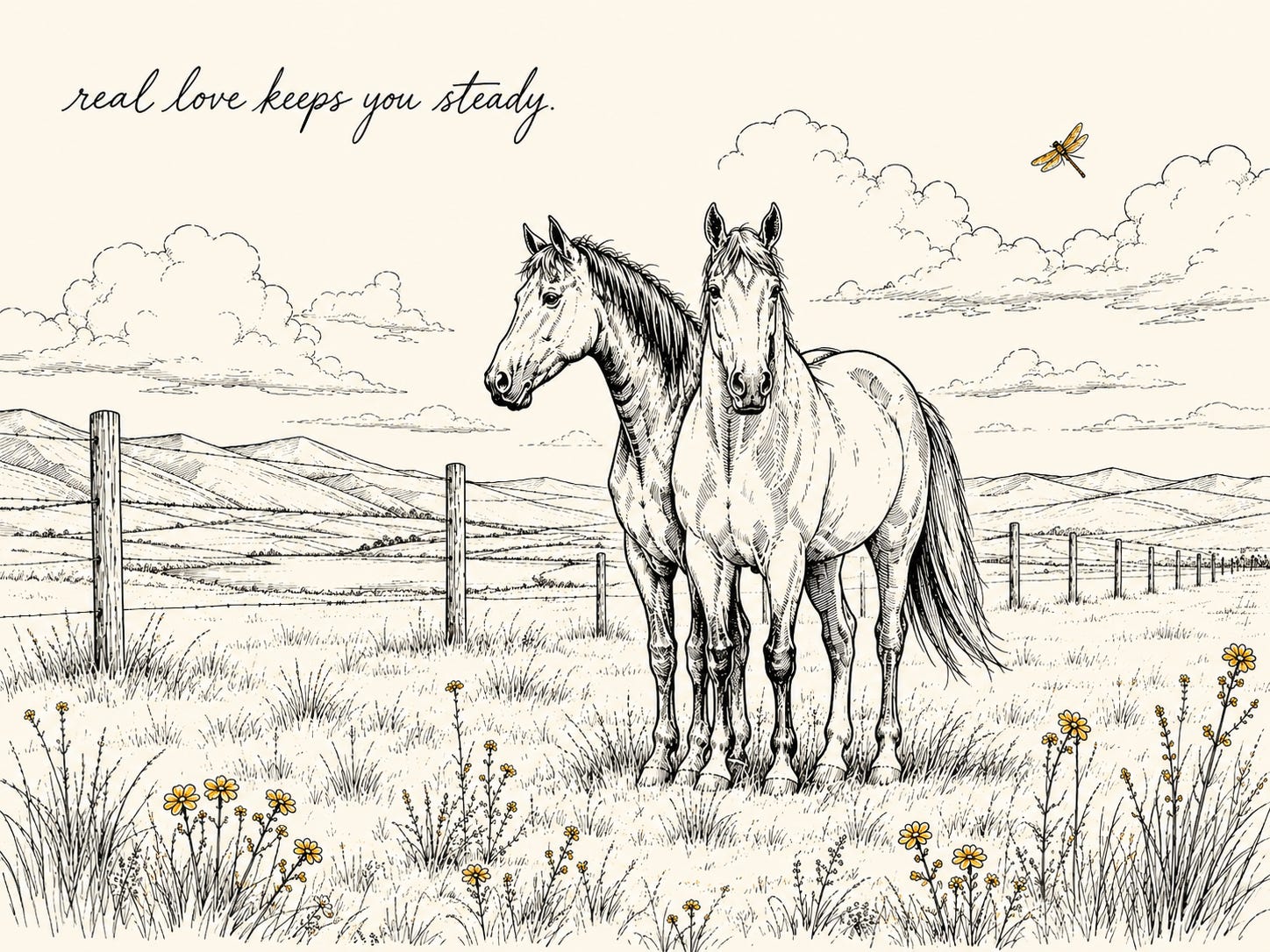
Two horses were standing close together in a paddock.
Their coats caught the morning light and looked like they’d been brushed with gold especially for our special occasion. They moved with a deliberate elegance and poise, unhurried.
I got out of the car and walked towards them. They suddenly looked up together, ears forward. Then they took a few steps to the side, exactly together at the same time. Stopped. Stared at me. Walked again, Stopped. Stared at me again.
This dance continued eight or nine times, and each time, neither one moved a second before the other.
It was a brilliant show, but kind of strange. Why did they need each other’s permission to move?
Still reading? Subscribe for more free posts - one thoughtful five-minute read, once a week.
The Science
The horses both moved, stopped, and rested within moments of each other.
A horse's eyes sit on the sides of its head, so it sees almost all the way around itself - about 350°, with 65° of this being binocular vision and the remaining 285° monocular vision.
It can only really focus with both eyes at once on a narrow strip straight ahead. Everywhere else is blurrier, good for catching movement but not for making out detail.
To get an actual, clear look at something, a horse has to angle the head so it lands on a thin strip of the retina called the visual streak, which is packed with far more light-sensitive cells than anywhere else in the eye. That's hard to do while walking forward, so they stopped to actually look at me.
Then they tried to figure out what the other one was focused on, by reading its eyes and ears. Horses do this specifically to work out where the others attention is. Researchers have found that they lose the ability to do this the moment their ears are covered, which means their ears do more than just hear. They point at whatever has their attention.
And finally, they synchronised movement. This was because they had a close bond which told them to protect each other. This relationship was what synchronised their movement more tightly than horses without one. Falling out of step with each other would leave them exposed, the safest place to be surrounded by others, so they moved as one.
It was a show of love built from the close relationship between them.
Where It Shows Up
In two people who have been married for decades and intuitively know to protect each other and their relationship from outside threats. They see their bond as a special service to each other, that moves them through life as one, loyalty and trust is their choreography.
In a toddler who is sitting at the top of a slide, ready to plummet down, but turns back to check the emotion on your face before going any further.
When starting a new job and hanging back in the first team meeting, because you don’t know the room yet. So you watch, read, to figure out who’s who before committing to speak up. You observe because getting it wrong might result in the wrong first impression.
The Subtextt
Beneath the feeling of amazement were two horses who were not simply copying each other. Each one was taking the other into account before it acted. Their bond changed the way they moved.
That is what service looks like in a close relationship. You don’t only ask, “what do I want to do?” You also ask, “what will help the person beside me to feel safe?”
Sometimes that means waiting for them. Sometimes it means noticing what they haven’t said. Sometimes it means changing your own pace so they’re not left to face something alone.
When both people live this way, protection doesn’t sit with only one person. It’s something that moves between them, and becomes part of their strength as one.
Over time, they become more careful with each other, more aware of what their choices create, and less concerned with moving through life on a single person’s terms.
Love, then, is not only a feeling between two people. It’s a function that keeps you steady, unhurried, and always in step.
And that deserves protection.