

The Idea
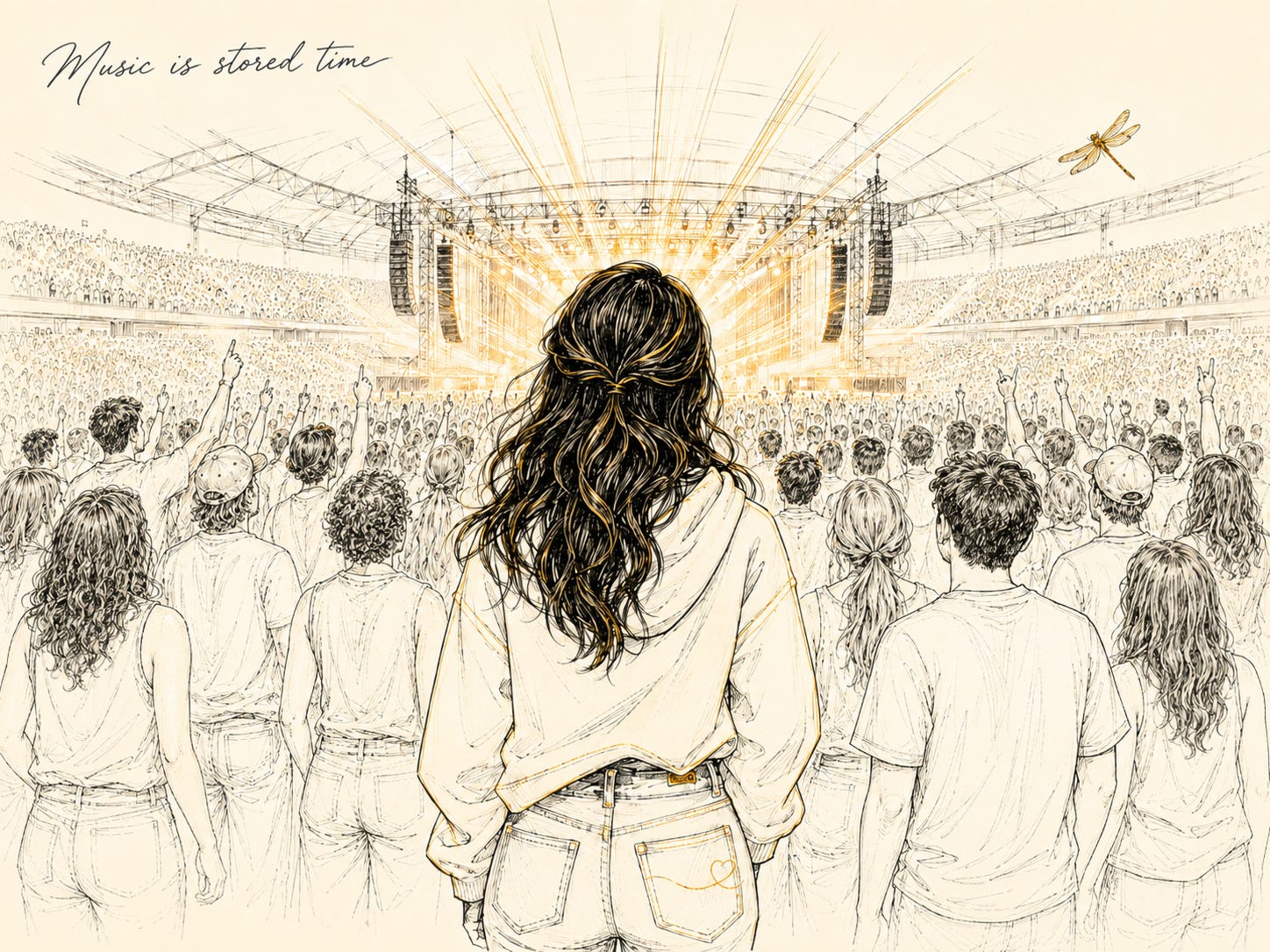
My favourite brothers were back together for the first time in a decade. Eighty thousand of us were packed into a stadium, ready to sing our hearts out together.
My hardest years had run on loop of their songs. I’d never thought in a million years I'd get the chance to see them live. But here I was, at an Oasis concert.
I felt like I was about to burst from being in a great big giant hug.
Then the music started, and the stadium suddenly erupted with the loudest roar. The kind that tells your ears that this is a moment you need to pay attention to because you’re never going to forget it.
And with it a wave of emotion started to rise. I couldn’t quite work out what it was at first. It felt warm and it hurt, and it was travelling quickly from my chest to my throat, and out through my eyes.
Cast No Shadow had started to play.
You’re crying. Stop it.
Thank god Fay’s on the other side of the stadium and can’t see this.
But I couldn’t.
Partly in joy. Partly because my teenage self had been drawn out and was now standing there right next to me.
She had travelled from a time I'd chosen to bury. Remembering that every relationship had made her feel exactly like this song, unseen. It gave her an invisibility shield that meant she didn't have to say the things she needed to say. Because who would care.
So she’d shut the world out, put her headphones on, and hit play on her walkman.
Except this time, she didn’t stay in the sadness for long. Because she was being carried through the sound of eighty thousand strangers singing which was holding her up.
Her tears stopped. She dried her eyes.
And then she wondered - how were they doing that?
Still reading? Subscribe for more free posts - one thoughtful five-minute read, once a week.
The Science
Music is one of the brain’s strongest memory triggers. Scientists call the memories it brings back music-evoked autobiographical memories. That simply means personal memories from your own life that return when you hear a particular song.
These memories can appear from hearing a few familiar notes that bring back a person, a place or a whole period of your life. Sometimes, they bring back the version of you who had lived through it.
The medial prefrontal cortex is an area near the front of your brain that helps connect familiar music with memories and emotions. This can be why a song can make the past feel very much in the present.
The more often you listen to a song which was from an important period of your life, the more closely the brain connects it to what was happening at the time. The song literally becomes a part of how you store that time in your life.
Decades later, your brain recognises the opening chords of a song, and begins filling in everything that once surrounded it.
That explains why my teenage self appeared.
What may have stopped my tears was something called collective effervescence, which is the powerful feeling that rises when a group becomes absorbed in the same emotion at the same time.
When you’re at a concert, the music pulls everyone’s attention towards the same beat, the same words and the same anticipated moments. People begin singing, moving and reacting together.
This shared rhythm can make the boundary between what I am feeling and what we are feeling soften. And the emotion becomes less lonely.
That night in the stadium my sadness entered a much bigger feeling. One where thousands of strangers replaced it with comfort.
Where It Shows Up
At a team karaoke night, and everyone joins in with the chorus. Suddenly the song you were nervous to sing alone becomes everyone’s.
In the car when you’re driving your children to school, and you know every word and sing far too loudly. The song becomes your shared memory.
During devotional singing, when the same words are repeated until individual voices begin to disappear into one sound. The feeling is still personal, but it’s no longer being carried by you alone.
The Subtextt
Beneath the feeling of a stadium singing as one is the idea that you don’t need to always be understood to feel less alone.
That night nothing about my past changed. But what did change was that I didn’t need to hold on to it by myself.
What weighs on you gets lighter the moment you’re not the only one holding it - whether or not anyone else knows what it is.
In that stadium, it was the sound, the crowd, the vibration of it all that reached in and filled the space where the sadness had been living alone.
And that was enough to stop me crying my heart out.