

The Idea
Every morning I give gratitude for another day. It’s another chance to learn something new and to make some small difference to someone else. I light incense to cleanse my mind, a ghee lamp to give me clarity, and listen to calming music.
One morning, I was in the middle of it when I heard screeching coming from outside.
It was panicked, coming from the balcony. I looked through the glass doors to see what was going on. It was a rainbow lorikeet, screeching loudly and looking around lost and confused.
Head down, then up, then left, then right. It could hear its companion but couldn’t see it. The screeching got louder, more frantic. It flew to the left, and then toward me, then back to the left, trying to work out where its other half was. Until it finally figured out it was on the balcony upstairs, and just like that it was gone.
I stood there for a moment, fascinated by what I had just seen.
It felt familiar. Almost exactly what I do when I can’t find my husband, although I don’t think he appreciates my screeches ;)
I’d always thought that the need to find the one person whose presence settles everything was just love between two people.
Turns out love is not uniquely human at all.
The Science
What sounds like screeching is actually a specific sound rainbow lorikeets make to locate their companion, when they can’t see them. You can think of it like a signature sound, the same way you’d recognise a specific person’s voice in a noisy room.
Lorikeets pick up new sounds throughout their lives from the birds and environment around them, adding to the range of calls they can make. So the sounds they produce keep changing and growing. This had always puzzled scientists because if their voices keep changing, how do they recognise each other?
Still reading? Subscribe for more free posts - one thoughtful five-minute read, once a week.
In 2023, researchers at the Max Planck Institute found the answer studying monk parakeets - another parrot species. Even though a bird’s call changes throughout its life, its voice always sounds like itself.
That consistent underlying tone, unique to each bird, is what allows them to find each other across distance and noise. It's called a voice print.
It’s the same way you’d recognise your best friend’s voice whether she or he is laughing, whispering, or singing. Something about it always stays the same because your brains learn the sound of the people you love and maps it permanently.
That morning the lorikeets used a distress call that only they could understand, and listened out for each other. That’s quite intimate, because in a way their voice prints - or calls - were serving one another.
Stay with me here.
When they were moving through trees, calling let the other know I’m here, stay near me.
When they were in danger, calling warned the other and said I will keep you safe.
When one flew off and they were separated, calling comforted the other and said I will find you.
So the voice print was in service of the relationship, and not just for survival.
It said,
I am here. Are you still there?
Come this way.
Don’t lose me. I won’t lose you.
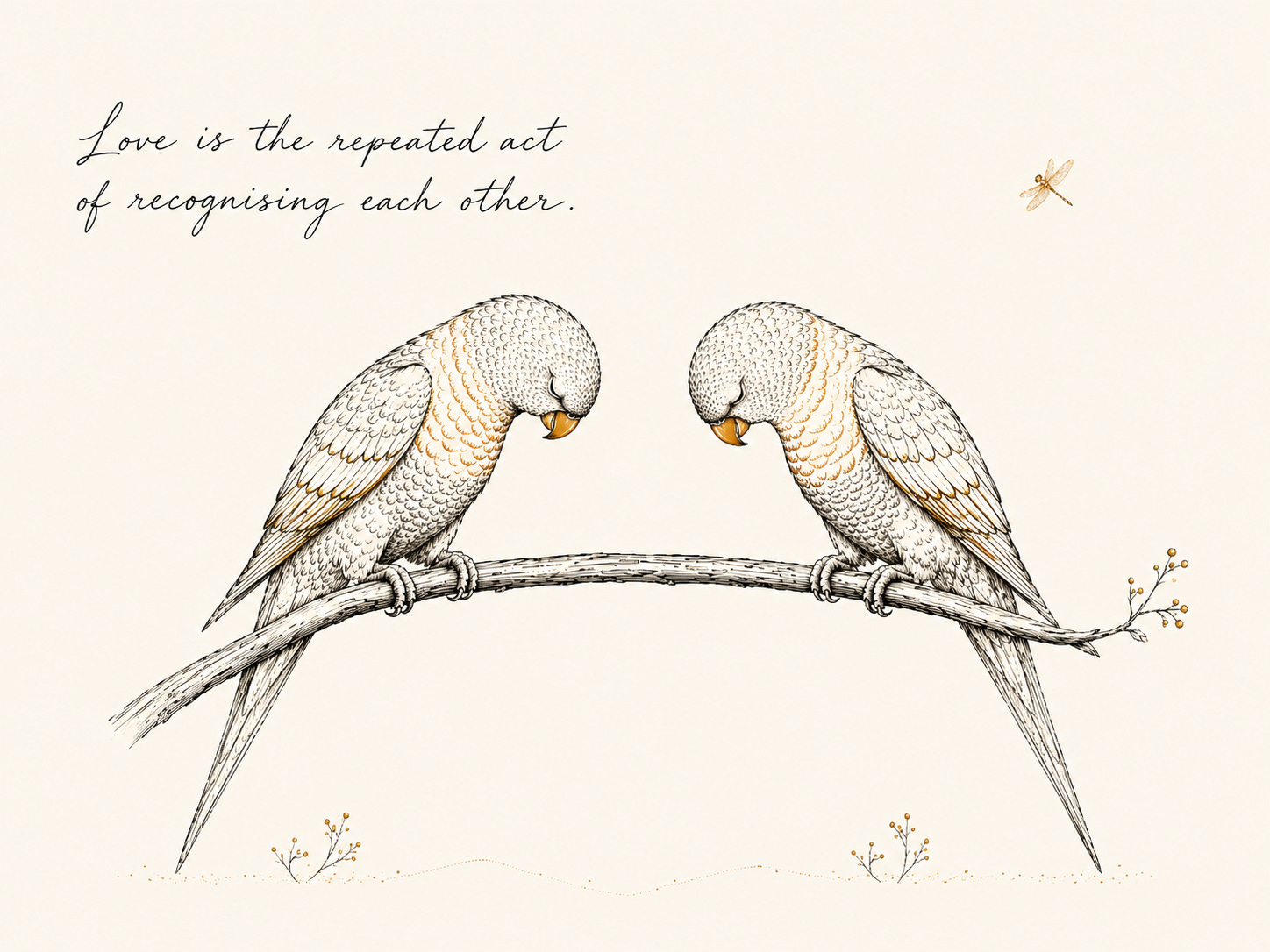
It’s love at its simplest. The repeated act of recognising each other.
Where It Shows Up
In a healthy partnership between two people who constantly check in on one another, so they know they are emotionally safe. They recognise when something is off before the other has said a word, and show up to the distress call. In times of despair, they take the lead and say follow me. It’s something most of us forget to do, almost always distracted by our own needs that we totally miss it.
It shows up in the relationships you have with your siblings and parents, who hear something shift in your voice and already know something is up. So they rally together to show up and make sure you don’t feel alone.
And it comes up at work, when a colleague notices you’ve gone quiet, and can see you’re feeling unsafe, so steps in. These people are your work lorikeets, because they pay enough attention to recognise others.
In each case, someone learned the sound of you. And didn't stop listening.
The Subtextt
Beneath the feeling of fascination is an important lesson that came from the most unlikely messenger, a lost lorikeet.
It called for its companion without hesitation. And it didn’t stop until it found it.
There are people in your life who have been doing the same thing. Learning the sound of you. Calling out to find you. It may be a partner, it may be family, it may be a colleague.
Whoever it is, the people who learn the sound of you often don’t know the effect they have.
Tell them today.