

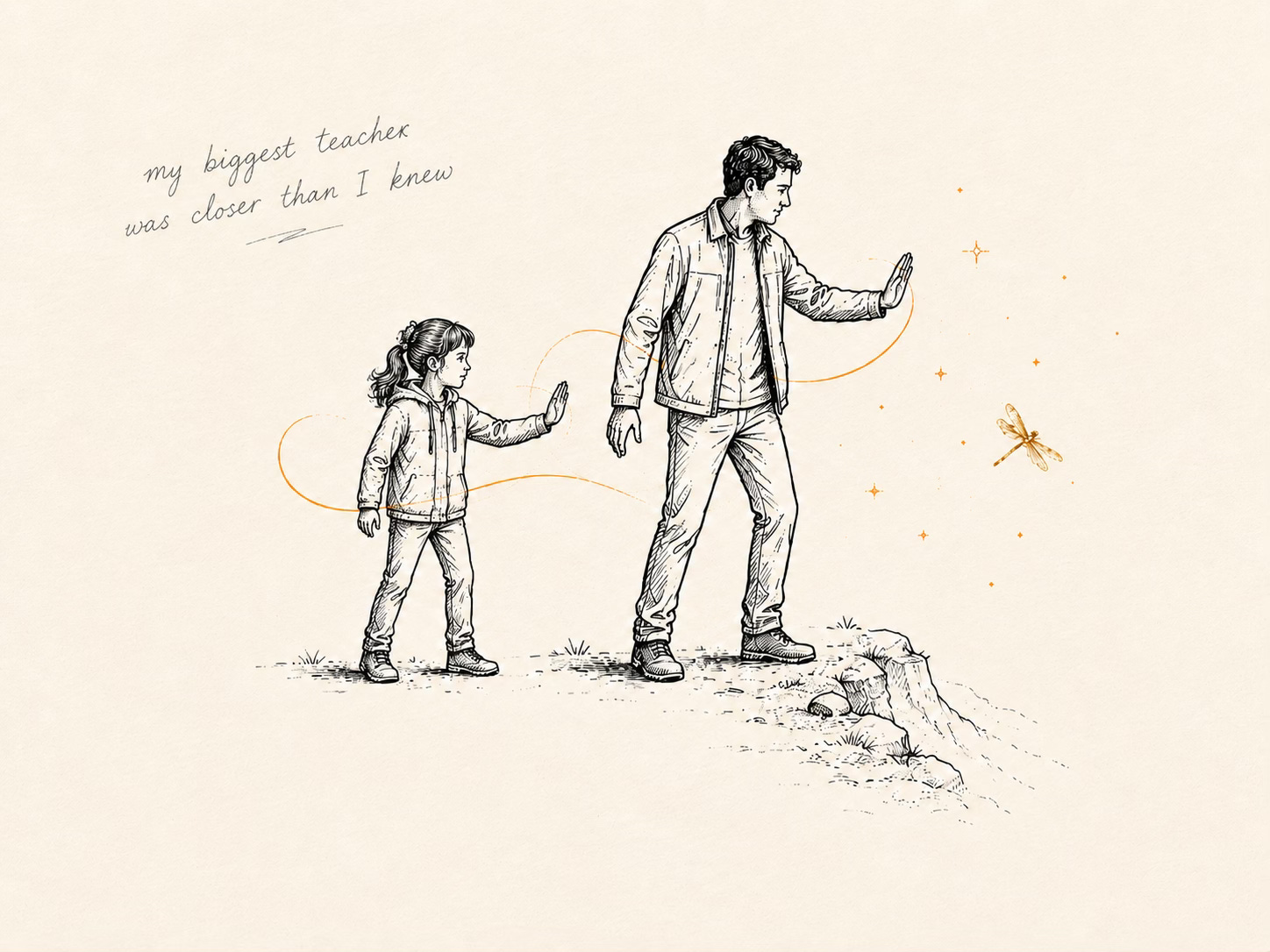
The Idea
In 1972, the dictator Idi Amin expelled the Asian community from Uganda. My parents were among them. They lost everything. Their home, their businesses, many of their belongings, and were forced to start life again in another country.
What’s interesting is that they never framed it as a tragedy. They just got on with things. Their determination, focus, and refusal to be defeated by circumstances that would have broken most people is what I watched across my entire childhood.
I absorbed it. And their story became a part of me.
When the chance came to move to Sydney, I can’t lie that I wasn’t scared. But underneath my fear was this undeniable truth that it was all going to be ok because my parents had shown me how to do it.
It took me a while to understand that had a scientific explanation.
The Science
Think about watching someone bite into a lemon. Your mouth waters, you wince slightly. Nobody bit your tongue, but your brain responded as if they did.
That’s because your brain doesn’t cleanly separate what you observe from what you experience - it participates instead. It does this through a system of brain cells called mirror neurons, which fire when you do something and also when you watch someone else do it. Your brain records and rehearses both.
Scientists stumbled onto this accidentally in the 1990s when they noticed that monkeys watching a researcher reach for food had the same brain activity as monkeys actually reaching for food. Nothing moved, but the brain responded as if it had.
What’s fascinating is that mirror neurons also read intentions. They fire not only when we see someone do something, but also when we understand what they’re trying to do. Which is part of why we can sense when someone means well, even before they’ve said a word.
The science is still evolving, researchers continue to debate exactly how much mirror neurons explain human behaviour. But what’s well documented is the observable effect that we are wired to absorb the people around us far more deeply than we realise.
Where It Shows Up
This happens more than we pay attention to.
When a friend leaves a stable career to start something of her own, you watch her navigate the fear, the uncertainty, the slow build. Somewhere along the way your brain files it all away, not as her experience, but as evidence of survival.
It happens when someone close to you goes through a painful breakup. The kind that unravels their whole life as they knew it. You watch them fall apart, being lower than low, and then slowly finding their way back to themselves. You’re not just a bystander, you’re taking notes the entire time so that if heartbreak ever finds you, you already know the way through.
The closer you’ve watched someone over time, the deeper that goes. It stops being something you know intellectually and starts being something you innately feel.
Spend enough time with someone and you start to mirror their body language, their speech patterns, even their emotional state. Their calm becomes your calm. And their resilience starts to become yours too.
The Subtextt
Beneath the feeling of being alone in what you’re going through, someone close to you has already walked this path. You just haven’t looked.
My parents didn’t know they were passing something on to me. They were just trying to survive. But while they did, my brain was scribbling notes so when the moment came that I needed them, I already knew what to do.
The stories of resilience we need are rarely as far away as we think. We don’t have to look to influencers, entrepreneurs, or people with a platform. The permission to see our own lives differently is usually already sitting right beside us, in the people whose lives have been running alongside ours.
Take a pause today and think about who that person is for you. A parent, a friend, a colleague, a neighbour. Someone who moved through something hard and kept going anyway. Write a sentence about what they showed you that you’ve been carrying without realising it.
And then ask yourself this: when people look back at your story, what would they say about how you moved through difficulty? What would they be grateful to have witnessed in you? Share them in the comments - I’d love to see them.