

This post supports World Suicide Prevention Day on 10 September. Losing a loved one too soon is devastating. If today is a hard one for you, I hope this helps..
If you need someone to talk to, Lifeline is available 24/7 on 13 11 14 in Australia, or 988 in the US. If you’re elsewhere, findahelpline.com can connect you to support in your country.
The Idea
It was a crisp spring morning, and my hands felt good in the gloves. Familiar, comforting, like being home again, in a way that nothing had quite managed to make me feel lately.
I’d booked myself into a session because life was changing faster than I could keep up with, and somewhere in it all, I'd started to feel a growing empty space inside me. Even though I knew things would eventually get easier with time, they hadn’t yet.
My mind was desperate for something else to focus on. So I went back to what had always worked before - boxing.
Kathy, my trainer, was the smiliest and strongest woman I’d ever met. She had the exact energy I needed to be around.
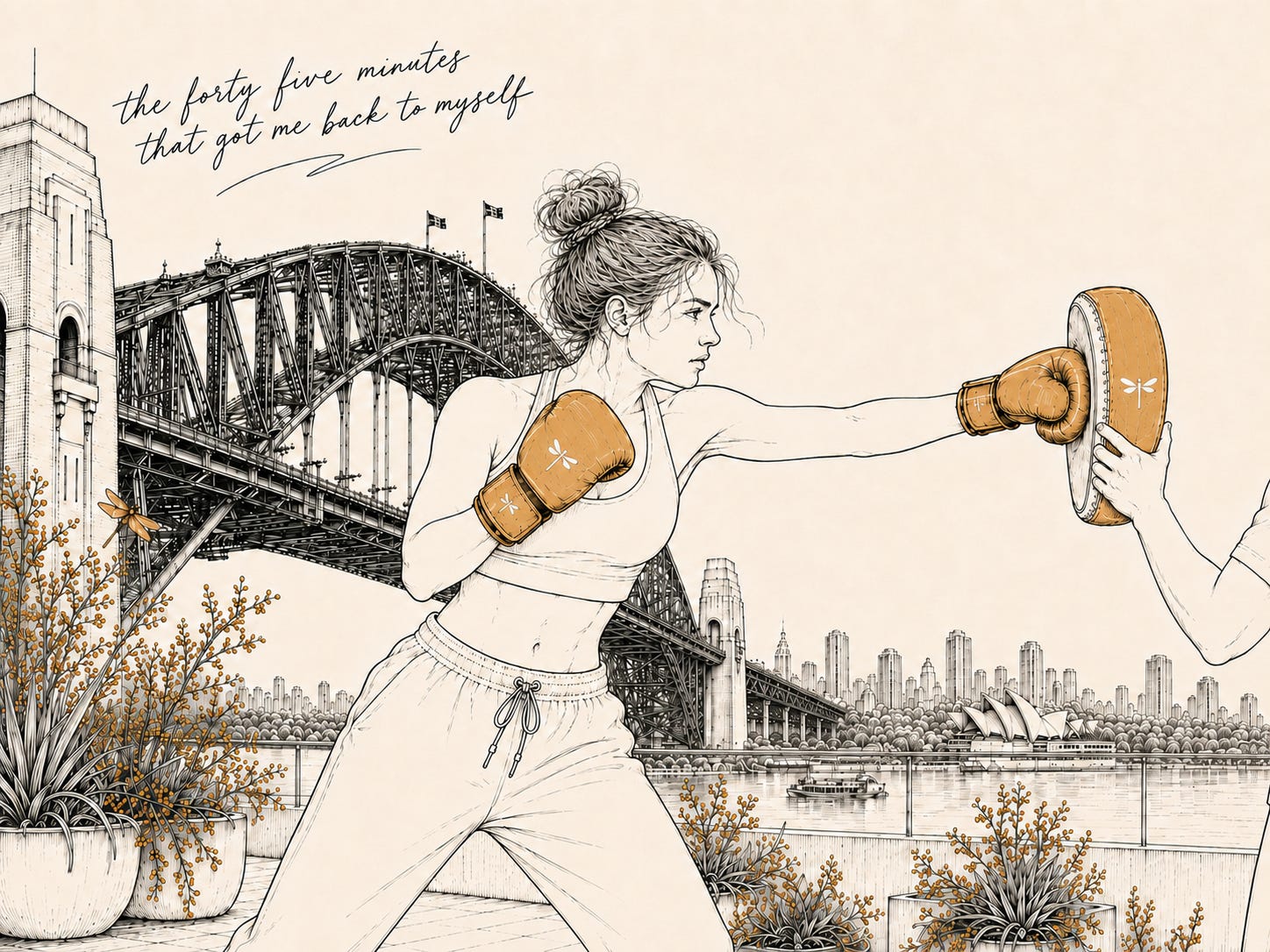
The session was on the sundeck, which had magnificent views of the Sydney Harbour Bridge, doubling up as an iconic backdrop. I was the first to box up here. I felt so lucky.
Because back when I had first moved here and nothing was familiar, it was the bridge that had steadied me. Giving me a constant structure I could depend on. Being in front of it now, so it could be a part of another new beginning, felt very special.
How long has it been? Kathy asked.
Years, I said.
I didn’t tell her exactly how many, but it had been long enough that I was completely petrified.
Gloves on. Pads up.
The first straight punches felt like riding a bike again. Easy.
Jab, cross, hook, cross!
The sequence was changing, and so was the pace. I was already out of breath.
I can’t do this. What was I thinking!
Keep going, Niki, you’ve got this, Kathy called, so I kept my hands up.
Jab, cross, hook, cross. Jab, cross, hook, cross.
I looked past her at the bridge.
I’m here with you, it said.
Jab, cross, hook, cross. Jab, cross, hook, cross, duck, Kathy wasn’t letting up.
My breath was now guiding me into each strike.
You can do this, Niki. C’mon! Jab, cross, hook, cross. Jab, cross, hook, cross, duck, kick.
I kept going.
Forty five minutes later, the gloves came down. My arms were shaking, my shirt was soaked through, but I had a huge grin on my face.
Something had changed in me. I felt different. Happier, lighter, more like myself again.
How had one class been able to fill that emptiness?
Still reading? Subscribe for more free posts - one thoughtful five-minute read, once a week.
The Science
Stress and changes can cause low-level inflammation in the body. That inflammation turns down a chemical in your body called dopamine.
Most people think dopamine is just the feel good chemical, but its real job is simpler than that - it’s what makes things feel worth doing.
A 2024 review by researchers at University College London looked specifically at why feeling low doesn’t mean you are sad — sometimes it’s more that you feel like nothing is worth doing. You’re constantly drained and your thinking goes foggy.
They pulled together decades of existing research. Examining animal studies on how dopamine drives motivation, brain scans of people deciding whether an effort is worth making, and research on how inflammation in the body can block dopamine from doing its job properly.
One of the main chemicals they discussed is called IL-6, which is a small protein your immune system releases whenever it senses stress, injury or a threat. It’s useful in short bursts, but when it stays raised for weeks - which is what tends to happen during ongoing stress - it blocks dopamine.
The researchers proposed this may be what causes the ‘flatness’ that’s felt.
And although the exact mechanism wasn’t fully understood yet, they proposed that exercise lowers inflammation directly, and that’s what brings back the sense that things are worth doing again.
So this might be exactly what was going on for me. My motivation switch had been down for weeks. But that morning on the pads, it came back on.
What’s interesting about this idea of using the body to change your state of mind is that it’s not a new one. An old Vedic teaching holds the same idea that you don’t calm an agitated mind by thinking about things harder. Because a mind that’s already spinning can’t out-think its way to stillness. The way to guide it to this is with action by giving it something to do with the body. The spinning then has somewhere else to go.
Breathing is one of the clearest ways the body can begin to do this. Although you can’t reach in and calm your thoughts directly, you can slow your breathing, so the mind can follow its pace. Which is why breath is so important in exercise and more than a background part of exercise.
But boxing adds something else on top of movement and breath - the act of striking itself.
A 2022 review of non-contact boxing — pad work, bag work, group boxing classes — says that having an experienced coach in your corner measurably increases people’s confidence and sense of agency, not just their mood.
So when I think about Kathy calling out combinations and keeping me moving, she was actually giving me real, measurable proof that I was still capable.
Where It Shows Up
When you feel flat and don’t want to get out of bed because something has knocked your confidence. You get up anyway and make the bed. It’s a small thing, but it gives you your first sense of achievement for the day, and that’s enough to make the next thing feel easier.
When something at work has left you doubting yourself, and then someone gives you a task you’re not sure you can handle. You do it anyway, it goes well, and that becomes proof that you’re still capable.
When your mind is racing before bed, and trying to not think about things makes it worse. So you slow your breathing down and after a few minutes, your body settles, and your thoughts begin to slow too.
The Subtextt
Beneath the feeling of emptiness is the reminder that who you are doesn’t disappear just because your mind has lost sight of it.
That day, I didn’t need to wait to believe in myself again. I just needed to move. Feeling low can make you feel less capable. But your actual capability exists beyond your thoughts, even when they’re telling you otherwise.
That’s why waiting for your mind to feel ready can keep you stuck. The mind gets overwhelmed. It loops, doubts and loses perspective.
So you have to switch the order up.
Moving your body first gives you something real to do. It lets action show you what your thoughts are struggling to see.
You don’t always need to feel ready before you move. The act of moving is what makes you ready again.
And most days, that’s all it takes.