

For a loved one lost too soon.
The Idea
It was 11pm. I was at my desk, laptop open, the rest of the house asleep. I’d been trying to write this post for hours, hitting the same wall over and over, and had no idea where any of it was going.
So I stopped for the night and headed to bed, ready to put the day away. But on this night something happened that had never happened before.
I was in my mind, and I could see my thoughts. They were travelling in shaped packets, though I couldn’t have told you what those shapes actually were. I just knew they had a shell.
Some were paired, some alone. But all of them were held together by a kind of diagonal current, pulling everything the same way, left to right, pulsing in time.
I could feel it. A humming electricity that was inside my head.
I knew I was sleeping. But I also knew, at the same time, that I was aware of being asleep.
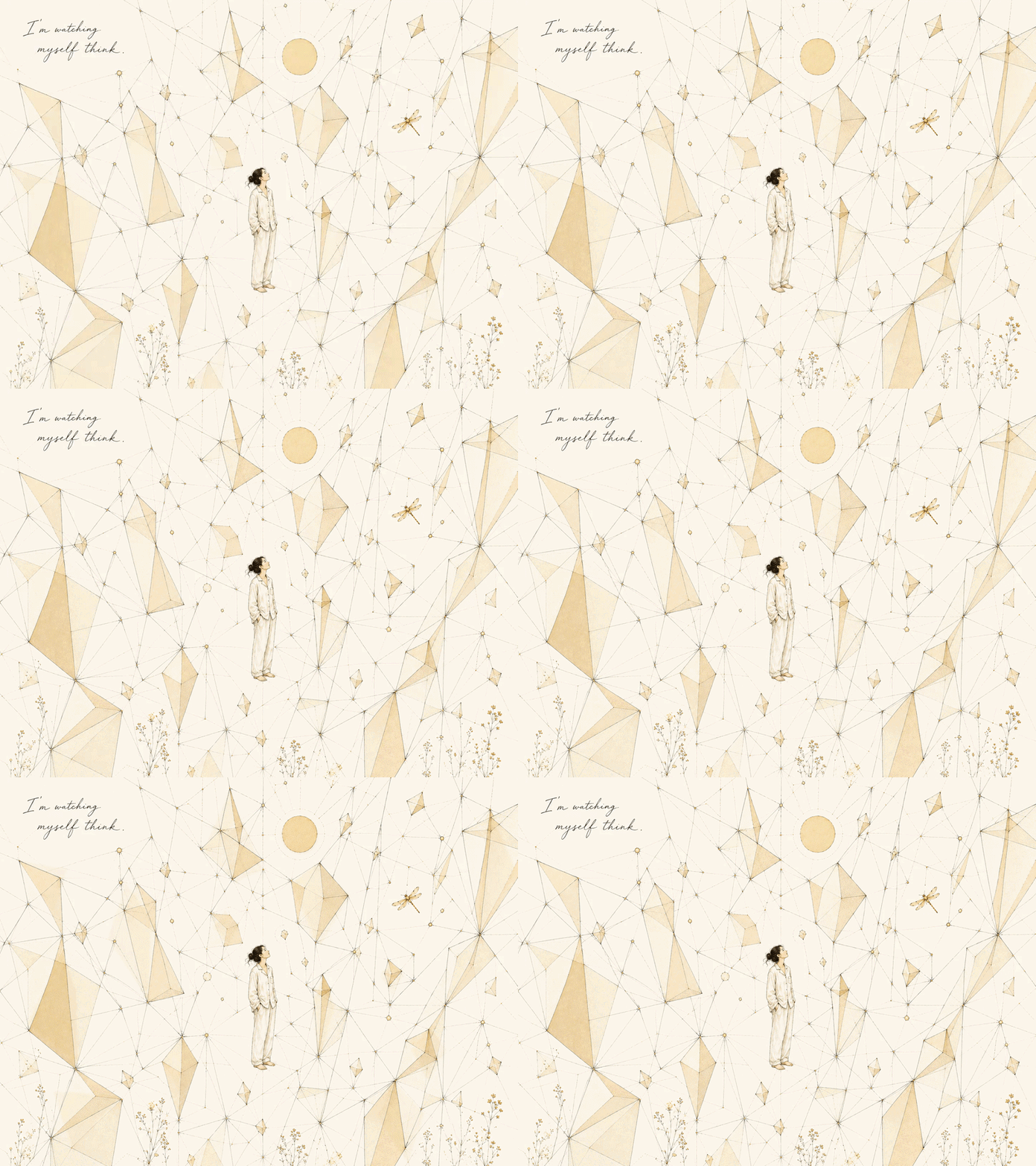
I’m watching myself think.
It felt strangely calming.
I couldn’t tell how long I did it for, but I didn’t want it to end.
Then I woke up.
I lay still, not wanting to move in case I forgot something. I’d read about the idea of observing the mind before. I’d never actually felt what it was like to be inside it.
I sat up in the dark and reached for my phone, then stopped — if I got pulled into something else now, I’d lose the detail.
Had I really just watched the thoughts in my head?
Still reading? Subscribe for more free posts - one thoughtful five-minute read, once a week.
The Science
Possibly, and it may have started long before I went to sleep that night.
I meditate every day. And this 2025 paper made me wonder whether there’s an effect I had missed. It describes detached self-observation as a core part of mindfulness, which gives the ability to notice your thoughts and feelings without immediately being pulled into them.
Over time, repeatedly giving your mind something to hold on to - such as breath, repeated word, or a bodily sensation - can strengthen its ability to observe itself.
Do it enough, and that self-awareness can become a familiar mental state that the mind returns to more easily. Researchers call this an 'attractor', because once the mind falls into that pattern, it tends to be pulled towards it again and again.
And although this skill is built during the day, it’s reported to happen to meditators at night too, when they’re lucid dreaming.
So meditation could explain how I was able to notice my thoughts. But another theory offers an explanation for how I was able to notice myself noticing them.
Developed by neuroscientist Karl Pribram, the Holonomic Brain Theory suggests that thoughts are patterns of electrical signals spread across the dendritic network in your brain.
This network runs throughout your brain and wherever brain cells connect to each other. It’s made up of dendrites, which are branch-like parts of brain cells that pass signals to each other, and together they form that network.
Those signals are your thoughts.
The network they are contained in behaves a bit like how a file is stored on a hard drive. Where a file gets broken into pieces and scattered across the disk. Similarly, parts of a single thought can sit across different points in the network.
Pribram says that the network spans across layers in the brain, and what happens in each one decides what you experience.
In the first layer, some thoughts are picked up by quick-acting circuits and turned into something you act on, almost immediately. Like trying to catch something the second it slips from your hand, before you’ve even decided to move.
In the second layer, other parts of your thoughts travel across the network for longer, delaying when you take action on them. Like laughing at a joke ten minutes after it’s told, once it’s finally landed.
Pribram suggests it’s this gap in processing time which decides how much of a thought reaches your conscious awareness.
His theory never explains how that actually happens, so that remains a mystery. But the slowdown may explain how I’d been able to watch my thoughts moving that night.
Where It Shows Up
When you’re driving and something appears in the road, you immediately swerve before you’ve worked out what it was.
When you interrupt a colleague talking because you’ve already connected where the logic is going.
When an answer to a deep problem finally arrives in your sleep, long after you’ve given up on it.
The Subtextt
Beneath the feeling of watching my thoughts was the fact that most of my thinking is never consciously done.
That night, I’d spent hours trying to force the words for this post. When I finally went to bed, the ideas that had felt separate were already connecting and shaping themselves.
They had their own identity and existence.
And because thoughts exist well before we’ve thought them, we should expect them to arrive when they’re ready, not when we call for them.
Which means this post may have been written well before I sat down to write it.