

Every now and then I write fiction to give the more creative parts of my mind somewhere to go.
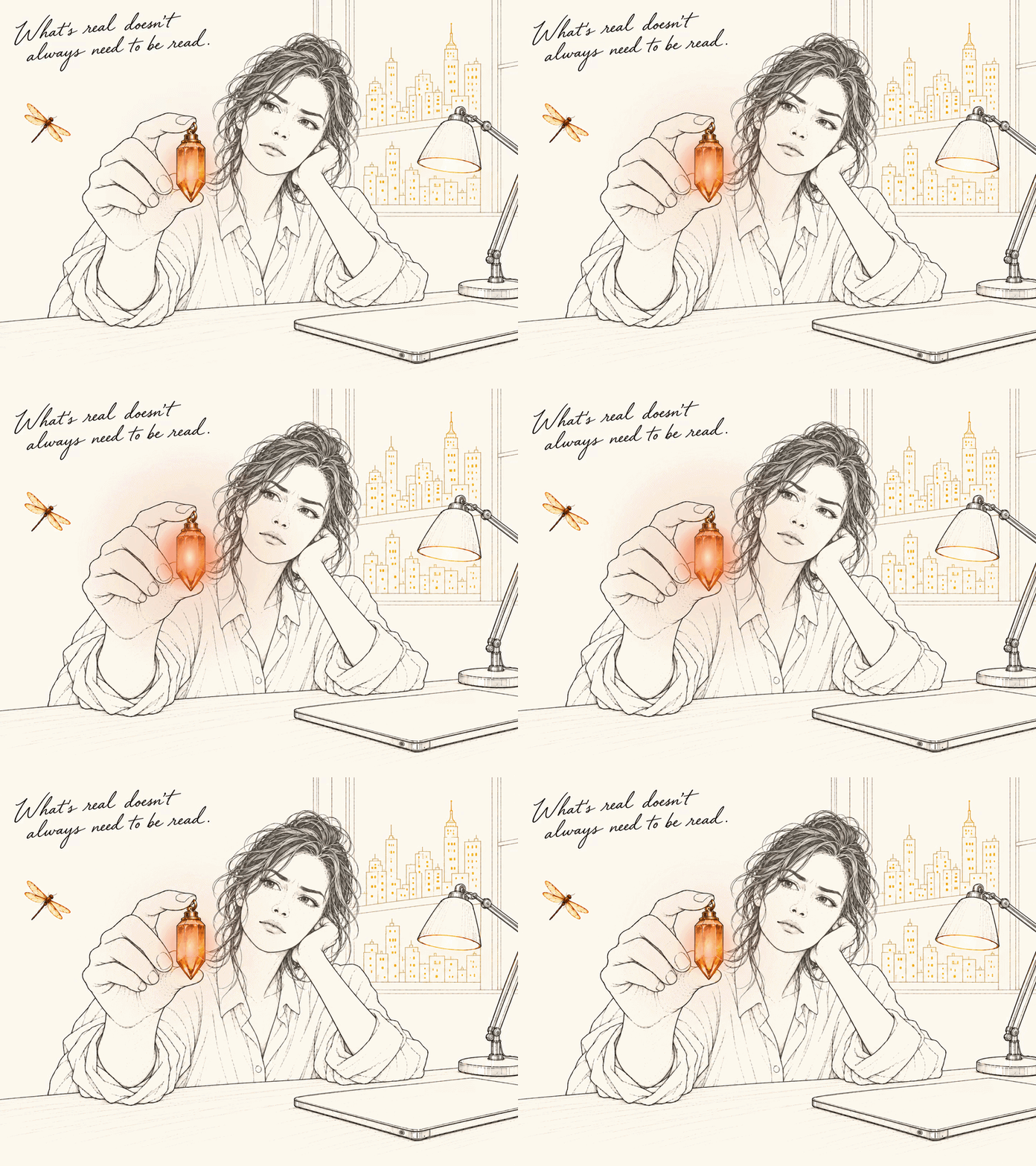
Ember has built a quantum sensor inside a tiny crystal that can turn signals from the body into light. Amber when you’re steady, red when you’ve reached your limit.
Then Ember goes further, promising to detect pain before you even feel it. For people whose pain has long been dismissed, it could change everything. Until one woman says she’s in agony - but her crystal say otherwise.
The Idea
On their very first day, every employee at Ember was given one to wear, carry, or leave in a drawer. The choice was theirs, although almost no-one chose the drawer.
It was a crystal, and inside it was a quantum sensor that detected the tiny magnetic field created each time a nerve fired in the body. Over time, it would learn how their nervous system behaved, and then turned that pattern into a colour.
Ari, the engineer behind it, had invented a shield that stopped the magnetic field from being drowned out by wifi, phones and other electrical noise around the office. It had been hailed a huge breakthrough in the medical field.
Amber meant steady. Red meant the nervous system had reached its limit.
Red ended arguments. People no longer had to explain that they’d hit their limit, the light gave a visible cue. Red ended scrutiny, and leaving work early from exhaustion no longer needed defending. It was the kind of readout that was impossible to ignore.
Ember’s mission was simple. To make “human energy, finally visible”.
And visible it was.
Within months of launching, the light was everywhere. Glowing red through a 9am standup. Managers checking their own crystal before booking someone in for the seventh call of the day.
And when Ember had its first product launch, companies had immediately bought it for their staff. As a result, workplaces had become kinder. Teammates were stepping in before a colleague turned red.
And for the first time, you could actually prove struggle was happening.
But Ari had been working on something new. Something that would radically change things as they’d known them.
Ember 2.0
It was three days before the launch of Ember 2.0, and Ari was stuck at her desk. It was 10.08pm and her Ember had been glowing an unmistakable red for hours.
“You’ve made your point.”
Ari looked up. Ember’s Chief Spiritual Officer was standing in the doorway.
The voice belonged to Charlotte, whose entire job was to remind the team that they were human. And that human beings, being human, had limits.
“What point?”
”You knew to stop hours ago, but you’re still sitting here ignoring it".”
Ari looked at the crystal.
”That’s annoyingly true.“
“You’re nervous about Friday.” Charlotte replied.
Ari didn’t answer. The original Ember had been really good at reading one part of the body. The new one would read several parts across different biological systems - nerves, muscles, hormonal changes to name a few.
For the first time, people would not just know what was going on in one part of their body, but what elsewhere had caused it.
That had opened Ari’s eyes to something she’d only hoped to solve someday.
Pain. Specifically, menstrual pain.
For generations, women had been speaking up about it only to be shutdown. Ember 2.0 would finally give them a way to be believed.
Prostaglandins were the hormones behind period pain. Ember 2.0 could read them spike before cramping was even felt. It meant women could know their pain was coming before it actually did.
During trials, the sensor had picked up a woman’s usual pain pattern eighteen minutes before her first cramp.
She’d laughed nervously. “So my body knows before I do?”
“Apparently so”, Ari said. “It’s incredible.”
And it was. She’d gone home that night thinking they had finally had a breakthrough. But Charlotte put a stop to that the next morning.
“Why do they need proof?
Ari looked up, coffee in hand. ”What?”
“You keep saying Ember will finally prove their pain is real. To whom?”
Ari stared at her.
“If a woman says she is in pain and Ember agrees, we believe her.”
“Right”, Ari agreed.
“But what happens when Ember doesn’t agree?”
The Test
The answer arrived during the final trial.
Annie’s Ember was amber.
“I need to stop”, she told the researcher.
“Your readings are normal. Do you want to go another ten minutes? It would help to capture the transition.”
Annie shook her head. “No, I said I need to stop. I’m in a lot of pain.”
The researcher stopped.
Later, in a progress briefing, Ari heard about what had happened. Annie had asked to end the trial. The researcher had checked her Ember, saw it was in normal range, and wanted to keep going. Only when Annie asked twice did she stop, she’d trusted the Ember over the person in front of her.
Ari replayed it. Annie spoke. The researcher checked the Ember. The trial stopped.
Charlotte said nothing.
“How did this happen?”
Ember existed because people weren’t very good at listening to their bodies. But they’d built it so well that people had started listening to it instead of listening to each other.
And now, weeks from launching a feature that was meant to make women’s pain harder to dismiss, they’d actually built a new way to do that.
Ari slowly sat down. “This wasn’t supposed to happen.”
“No”, Charlotte said. “But it’s what people will do.”
Ari hated when she did that.
The Subtextt
Beneath the feeling of disbelief is the truth that we’d rather look outside ourselves to make sense of what is going on within us.
That refusal to understand our inner lives is what makes it so easy to hand the responsibility to something else.
Ember’s read on pain was useful, but it was a stand in for the person who was experiencing it - who was the real source of truth.
The more intimately we know ourselves, the harder it is to see other people as completely separate from us. We can recognise their fear, anxiety, and exhaustion because we know something about it ourselves.
Care then is more than a measured act of kindness. It’s the whole point of what it means to live alongside others in this world.
It becomes human work that belongs in ordinary days, as well those not so ordinary days.
Black mirror style