

The Idea
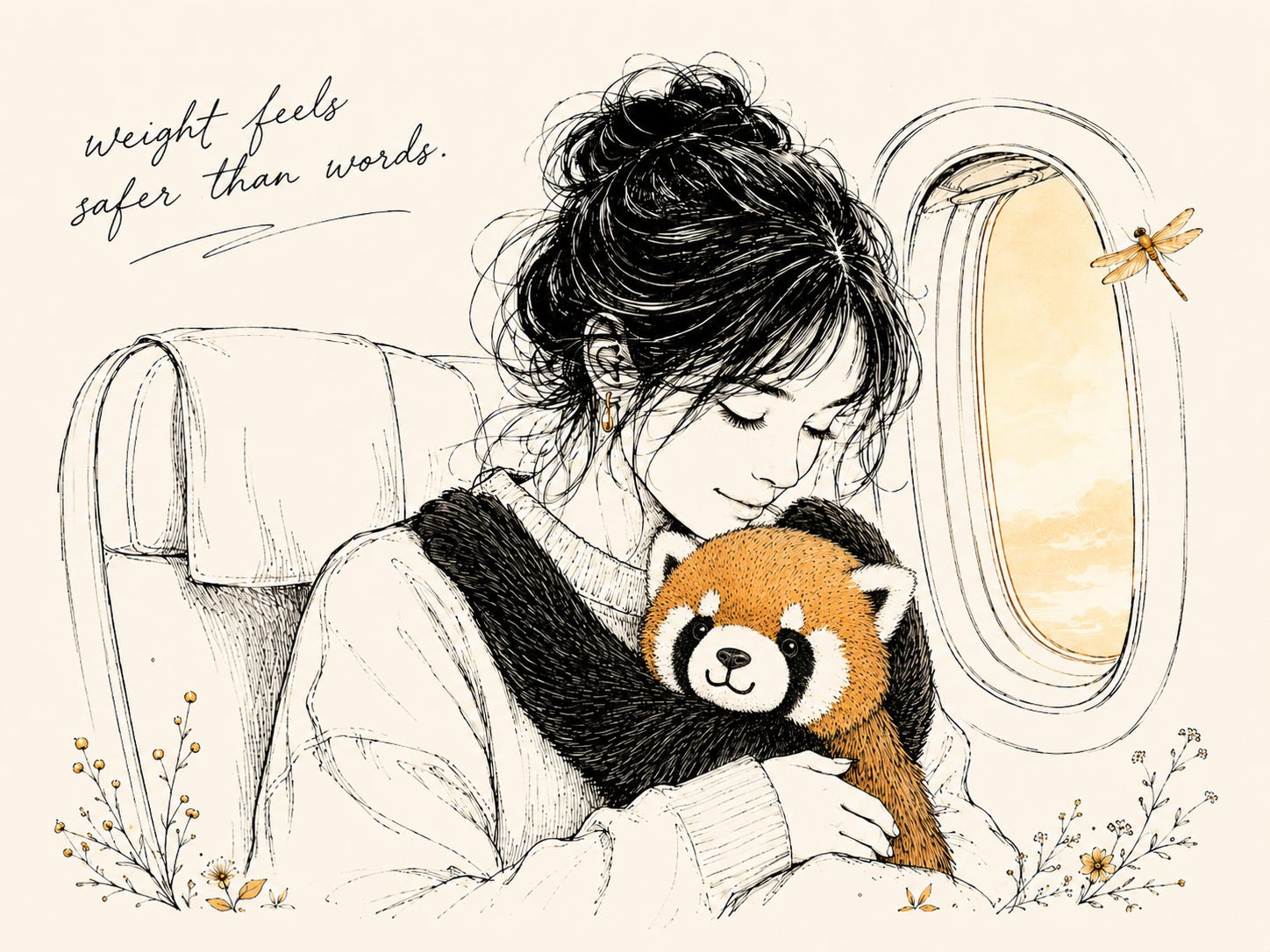
The night before I flew to London, I packed a red panda in my carry-on. His name was Rem Rem, and he had long weighted arms, round ears, and a smile that wasn’t going to disappear because of bumps in the air.
I’d brought him because I was a nervous flyer and I’d read that deep pressure therapy was good at promoting calmness. After a run of turbulent flights around Australia and New Zealand, I was desperate enough to try anything.
I’m going to look ridiculous, but this will be a fun experiment.
Rem Rem had extra-long weighted arms designed to wrap around you. The idea was that the weight of these across my body would mimic the feeling of being held - like receiving a hug.
Every time the plane went up on take-off, my stomach would drop and I’d spend the rest of the flight hyper sensitive to the smallest bump in the air. It had happened enough times now that I started dreading things from the moment I booked a holiday.
I boarded the flight to London already drained from it all, Rem Rem’s arms sitting across my shoulders.
A few hours in, the turbulence hit. The plane shook, the lockers rattled, but instead of gripping the armrest, I looked down at Rem Rem.
He was still smiling, still calm.
The panic I’d been bracing for didn’t arrive.
The Science
Your body is covered in tiny sensors found within your skin, muscles, joints, and inner ear, that track movement, pressure, and vibration. They’re called mechanoreceptors and they feed your brain a constant stream of information about where you are and what's happening around you.
For a regular flyer, the brain registers take-off, the tiny movements of the airframe, the shift in altitude, as unremarkable. But for anxious flyers who are already on edge, something different happens. The same data gets read as urgent instead.
The stomach drop felt on take-off gets interpreted by the nervous system as a warning, rather than a routine part of flying. When turbulence starts, the inner ear and eyes send the brain conflicting information, telling it the body is feeling movement that the eyes can’t account for.
The brain reads that conflict as threat, which is why it’s so frightening even when you know the plane is fine.
Deep pressure works through the same system but tells your body the opposite story. When even weight is applied across your body, the tiny sensors activate the vagus nerve. This is a long nerve that travels from the base of your brain through your chest and into your gut. It’s responsible for regulating your heart rate, your breathing, and how your body responds to stress.
Its activation pulls you out of fight-or-flight and into rest-and-recover. Your cortisol drops and you stop treating everything around you as a threat.
The weight of Rem Rem’s arms feel like a hug from a loved on, reassuring the body:
I’ve got you, you’re safe, I’m still here
During turbulence it gives your nervous system something solid to hold whilst everything else feels uncertain - and it works.
Where It Shows Up
You may have heard of weighted blankets that work on the same principle. First developed for children with sensory processing differences, they offer steady pressure across the body throughout the night. People who use them regularly report lower cortisol and better sleep.
The weighted blanket market is projected to reach $3.82B by 2035 - something airlines should pay attention to.
The hugs you receive from people work the same way - but only if they last long enough. Researchers have found that a hug needs to hold for around 20 seconds for it to be registered as safety, rather than touch. A proper hug held long enough will visibly soften you, causing your shoulders to drop and breathing to slow down.
There’s even a small wave of adult-sized swaddle sleeping bags on the market now. Fully grown adults are tucking themselves into something that mimics being tightly wrapped. It sounds a little silly. But it works for the same reason everything else here works.
The Subtextt
Beneath the feeling of fear on a flight is a body that doesn’t believe what it’s being told.
You can know logically that the plane is fine. Pilots fly through worse conditions, and i’m told that you’re statistically safer on a plane than in a car. But none of this information reaches the part of you that’s afraid, in the moment you’re afraid.
That’s because fear doesn’t live in the part of the brain that listens to facts. It lives in the part that listens to sensation.
Which is why my beautiful red panda with weighted arms did something a thousand reassurances couldn’t do. It gave my nervous system the one thing it actually trusted - the feeling of being held.
The next time you’re scared and the facts aren’t landing, stop reasoning with yourself. Find something to hold you instead.
Love this Niki! So glad Rem Rem helped you through the loooong flights 🥰