

The Idea
The day was finally here. I was on my way to the Great Barrier Reef, and I was so excited.
We’d left early in a small catamaran, the water shone like diamonds under the morning sun. I stood near the front watching it for most of the hour it took to get there.
Then the engine cut, and it was time to get in.
Are you crazy! You can’t swim.
I had known this the entire time I was booking the trip, and somehow I hadn’t accepted the risk I was taking until I was standing on the deck in a wetsuit looking out at the open ocean.
The diver went through it with me - I'd hold onto a ring, he'd stay with me, he'd move me around. I nodded nervously.
The cold hit first. Then the waves, which had looked gentle from the deck but were not so gentle after all. They pushed me sideways, lifting and dropping me up and down. I held on for dear life, too scared to do anything.
The diver moved me across the surface to a spot where he said there’d be something worth seeing, and told me to look down.
So I took a deep breath and went under.
Everything fell silent.
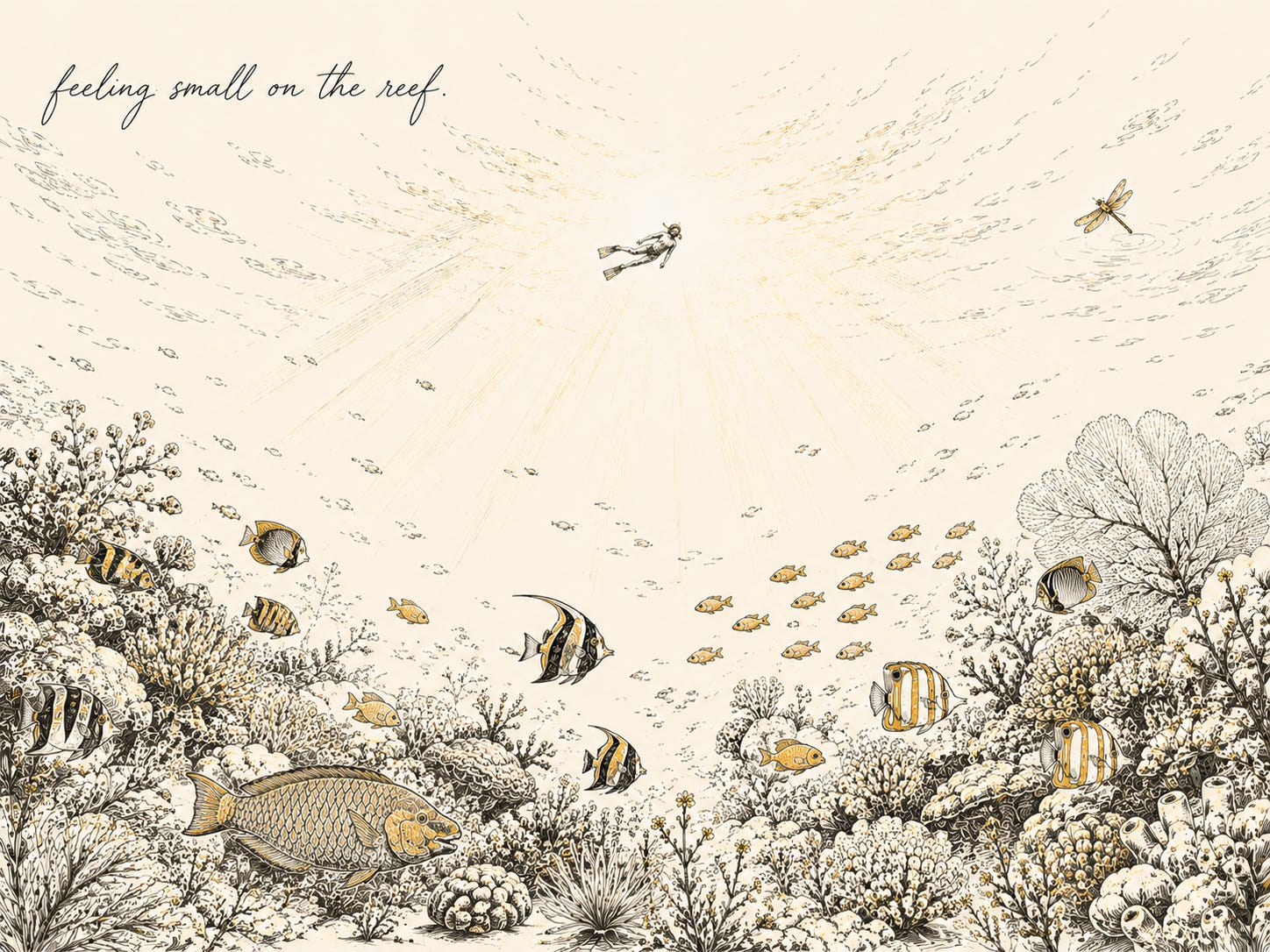
There was an entire world, with fish everywhere. Tiny ones moving fast in groups, bigger ones drifting past without hurry, and coral in shades of gold and green. All of it was busy. All of it was going about a day that was happening without me.
I was a guest.
Uninvited, unnoticed, completely irrelevant.
My heart opened with joy.
Still reading? Subscribe for more free posts - one thoughtful five-minute read, once a week.
The Science
The Great Barrier Reef is around 500,000 years old, with some of its coral structures millions of years old. It stretches over 2,300 kilometres, and is home to 1,500 species of fish, and 600 types of coral.
Healthy coral reefs are surprisingly noisy places. Underwater, a reef sounds like something frying in a pan; the result of snapping shrimp around three to five centimetres long.
Snapping shrimp have one oversized claw that closes at around 60 miles an hour, fast enough to create a collapsing bubble of air. The pop it makes can stun a small fish, and measures above 190 decibels - putting it in competition with the blue whale for the loudest animal in the ocean. The frying sound is thousands of them snapping at once, hunting across the same stretch of reef.
Snapping shrimp can’t survive without coral, so the amount of snapping tells you how much living coral is there.
But I heard none of this, and here’s why.
Human ears are built for air, but underwater the middle ear stops transferring sound properly, and everything gets sort of muffled. It’s like having cotton wool pushed into your ears.
And because sound moves through water around five times faster than through air, sound travels straight through your skull instead of being blocked by it.
Which is why everything fell silent.
Where It Shows Up
When you’re at the base of a waterfall and the sound stops you. Its roar is so loud that it’s difficult for your ear to pick it apart, drowning out the sound of your own voice and thoughts. You stand there humbled, emptied of whatever you were carrying, aware of how small you are next to it.
When you step inside a temple and whatever you carried in with you feels smaller by the time you leave. The scale of the place, the quiet, the sense of something much older than your own problems puts them in proportion.
And the moment you accept you cannot control what another person does to you. The arguments in your head stop, and you feel a stillness from knowing the experience was never sent to wound you, but to wake you..
The Subtextt
Beneath the feeling of being underwater was the fact that insignificance is strangely freeing.
That day on the reef I found an entire civilisation running perfectly with no regard for me. Busying around with an intelligence that had long existed before me. Even the silence belonged to it.
Most of your life is spent trying to matter, each day pulling you back to your choices, your problems, your story.
But the reef reminds us that we expand in insignificance. Being small doesn’t mean you are less, it means feeling how much larger everything else is.
And that, weirdly, makes the world so much bigger.