

The Idea
It was my first summer in Sydney, and my skin was completely drenched in melted sun lotion.
This was the day I was heading into the bush. Australia's second oldest National Park promised a hike through open forests, a historic boat shed, through a marina, before eventually arriving at a picnic area.
And I was at the beginning of the track, dripping from the heat.
What’s that noise?
It was like a faint buzzing coming from above me, but I couldn't see anything up in the trees. So I thought nothing more of it and carried on. But the deeper I went into the forest, the louder the faint buzzing became.
Eventually I passed two hikers, who were going the other way.
Watch out for the lace monitors on the track, one of them said.
I had no idea what they were referring to. They explained that they were very large, dark lizards with yellow spots that crossed the path without warning.
Perhaps they were the one’s making the noise.
No, it sounds like power lines. There has to be power lines somewhere in here.
I looked. No towers. No wires. Maybe they were buried somewhere in the forest that I couldn’t see. But power lines don’t tend to get louder the closer you walk toward nothing.
There it is again.
A few short pulses. Zzt... Zzt... Zzt... Then one long drone, Zzzzzzzzzzz, before it dropped off. It was surrounding me now, coming from everywhere at once.
Then it began again.
It was as if the whole forest was chanting to something, but I had no idea what the eerie chant was.
What was I listening to?
Still reading? Subscribe for more free posts - one thoughtful five-minute read, once a week.
The Science
What I was hearing was the mating call of cicadas.
They spend years underground as nymphs, feeding on root sap. And only emerge in the summer for a few weeks with one purpose only - to mate before they die.
Here’s how they were making that sound.
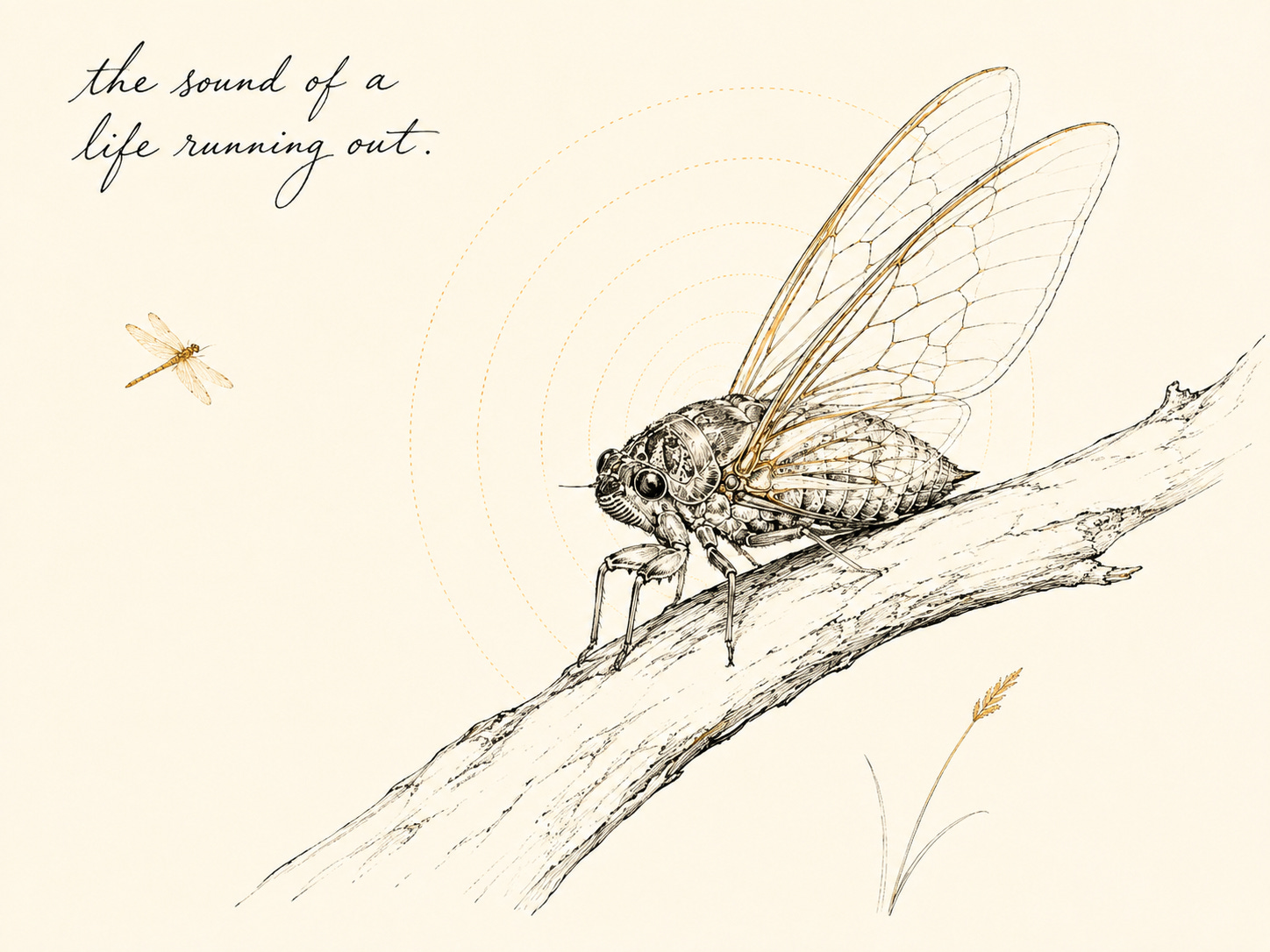
Cicadas have thick, dark bodies and clear, veined wings held over their backs. At around five centimetres long, they are surprisingly one of the loudest insects in Australia. Their calls can reach over 120 decibels when several are calling together.
The males have two large red-brown sacs on either side of their abdomen.
Each of those sacs covers a rigid, ribbed membrane called a tymbal. Powered by the cicadas nervous system, a muscle pulls on the tymbal until it buckles, then it relaxes it and lets it snap back. The buckle is what makes a clicking sound.
So when I heard Zzt... Zzt... Zzt, that was the muscle clicking slowly enough for me to hear it on its own. When it dropped into one long Zzzzzzzzzzz, the muscle had sped up. And hundreds of clicks a second blurred into a single droning sound.
That still didn’t explain why it was rising and falling together, like a sound wave.
Cicadas call in unison when their numbers are dense enough. Each male reacts to the other males around him, matching his rhythm to theirs in real time. One male starts. his neighbours pick it up within moments, and just like that it spreads through the whole population like a giant deafening wave.
Its reproduction turned all the way up.
Where It Shows Up
At a concert, applause can begin as hundreds of separate claps. Within seconds, people hear the rhythm around them and unconsciously fall into time with it.
A crowd walking across a bridge where each person makes tiny adjustments to their steps in response to the movement beneath them, which can eventually cause thousands of footsteps to synchronise.
And in conversation, people begin matching each other by subtly adjusting their pace of speech, pauses and even movements - without consciously deciding to.
The Subtextt
Beneath the feeling of electricity was an urgent vibration.
The cicadas sounded endless.
But this was their first summer above ground, after years of preparing for a life that would only last a few weeks. Once they emerged, they had a remarkably small window to find one another, mate and complete the reason they had surfaced at all.
Then their lives would end.
Which changed what I was hearing.
What had seemed excessive was actually creatures with almost no time to waste. Every call was desperately reaching for another cicada while there was still time to be answered.
The whole ritual was a like a weird biological countdown. Serving as a stark reminder that we should always move with urgency.
Perhaps the real warning here is how easily we live as if there will always be more time.
But maybe the whole point of life is not to live faster, but to live with less delay.