

The Idea
It’s 5:30am and I’m at Bondi Beach, cuddled up with my husband, waiting for the sunrise. Around us, dotted along the sand, are others who have come to do the same.
There’s something ritualistic about this, which I love. A community of people have shown up to watch the sky turn golden.
But as I’m sitting here, I feel a sense of shame. Because while I’m waiting, there are lots of people already moving. Runners on the beach, swimmers moving in the early swell. And closest to us, a yoga group, stretching in near silence as the light begins to come in.
There’s a simple philosophy behind what I’m watching. Rise with the sun. Move with its energy. Because the early morning carries the highest vibration of the day, and these people know it. They are in sync with something most of us sleep through - including me - well, except for today.
My eyes stay on the yoga group. The way they stretch deliberately is like they’re greeting every part of themselves before the day starts.
And it reminds me of something I’d read about ants.
The Science
In 1953, a Cambridge-trained entomologist named Derek Wragge Morley published a book called The Ant World. He had been studying ants since he was fourteen, and what he documented about their waking behaviour is, in his own words, a very human-like ritual.
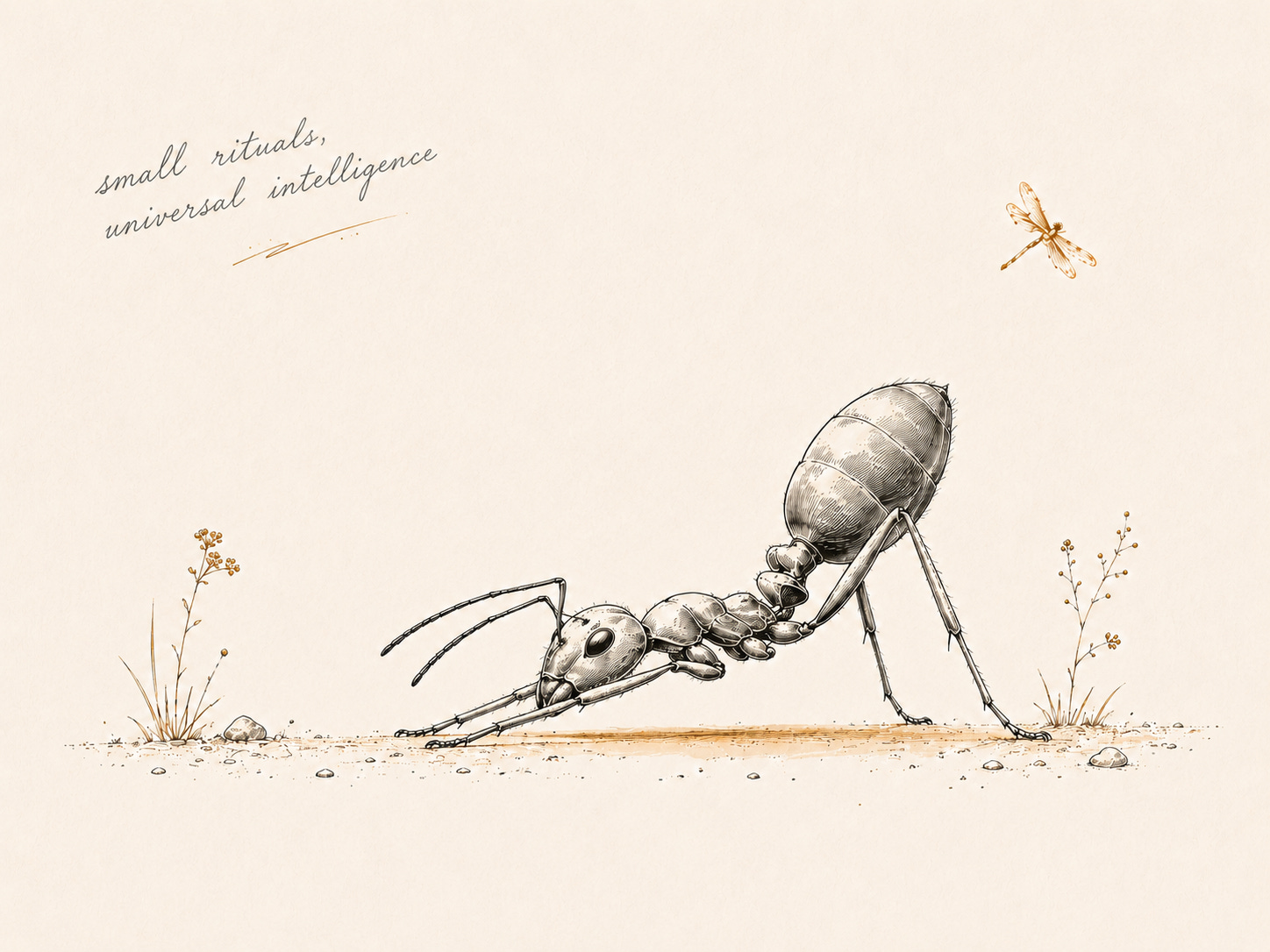
When an ant wakes, it stretches every part of its body before it moves. Scientists have a word for this - pandiculation. It's the involuntary urge to stretch on waking. Humans do it. Dogs do it. And as it turns out, so do ants.
After the stretching comes what Wragge Morley calls a prolonged grooming. The ant systematically cleans its antennae, head, and body before it does anything else. Only after both are done does it get started with its day.
There’s a reason for all of this. An ant finds its way through the world almost entirely through its antennae, picking up chemical signals that tell it where to go, what to eat, and who to trust. If those antennae are dirty from sleep, the ant is essentially operating blind. The grooming fixes that, and the stretching wakes the muscles up. Neither step gets skipped.
Similarly, humans have known this for thousands of years. Ayurvedic medicine, which is an ancient Indian approach to health and wellbeing that predates modern medicine, has been recommending the same morning sequence: to stretch and move when you wake up, then cleanse the body before the day begins.
The practice is called Dinacharya. The ant does it in minutes, for humans it’s takes a bit longer. But the principle is the same: move first, then clean the body, then begin your day.
Where It Shows Up
A friend told me that her cat does this every single morning - stretching every part of its body when it wakes up. She’d never thought about why. Most people who have pets will have seen the same.
If you’ve stayed at a wellness hotel, you might have signed up to a morning yoga session which is almost always the first thing on the schedule. It’s always at sunrise, before breakfast, and before you do anything else.
And whilst yoga has become a modern fitness trend, it’s actually rooted in Hatha yoga, the physical practice that most modern yoga descends from. It was never designed as exercise, but a preparation ritual used by Hindus and Buddhists as a way of waking the body up before meditation.
The Subtextt
Beneath the feeling of the stretch is the truth that we are just like ants.
The pull you feel to lengthen and reach before you get out of bed is something your body wants to do. The ant knows it, the cat knows it, and history knows it.
Somewhere along the way, we gave our innate wisdom on stretching away to the fitness industry, confusing it for something done at the gym, or a yoga class.
But that’s not what it is. It never was.
Stretching is intimately connected to who we are, with the natural world, done universally.
Before you reach for your phone tomorrow morning, let the stretch happen. The ants will be doing it, so you're in good company.