The Bogong moths have missed their exit. Or have they?
The cosmic twist behind Sydney’s Mothpocalypse.
 Niki Virdee
5 min read
The Idea
There was always a queue outside.
We waited about twenty minutes to get in, an acceptable wait time for some of the best Malaysian food in Sydney. Inside it was busy and loud, but not so loud that we couldn’t hear each other.
It was my usual monthly catch up with Juliany and Parisa, two of my closest friends.
Seeing them was always an evening of extreme laughter, the kind where it hurt. The kind where the people sitting at the table next to you would stare, annoyed, hoping you would notice their frustration and stop.
At some point the conversation turned.
“What’s the furthest you’ve travelled without knowing exactly where you were going?” I asked.
“I went to Carnival in Rio once,” Juliany said proudly. “I got totally lost for hours, no idea what neighbourhood I was in but I made so many new friends.”
“You can’t get lost,” Parisa exclaimed. “Either Google Maps or someone is going to tell you where you are!”
That’s how I the conversation turned to moths. I’d been watching the Mothpocalypse on Instagram. People were being ambushed by Bogong moths in their homes.
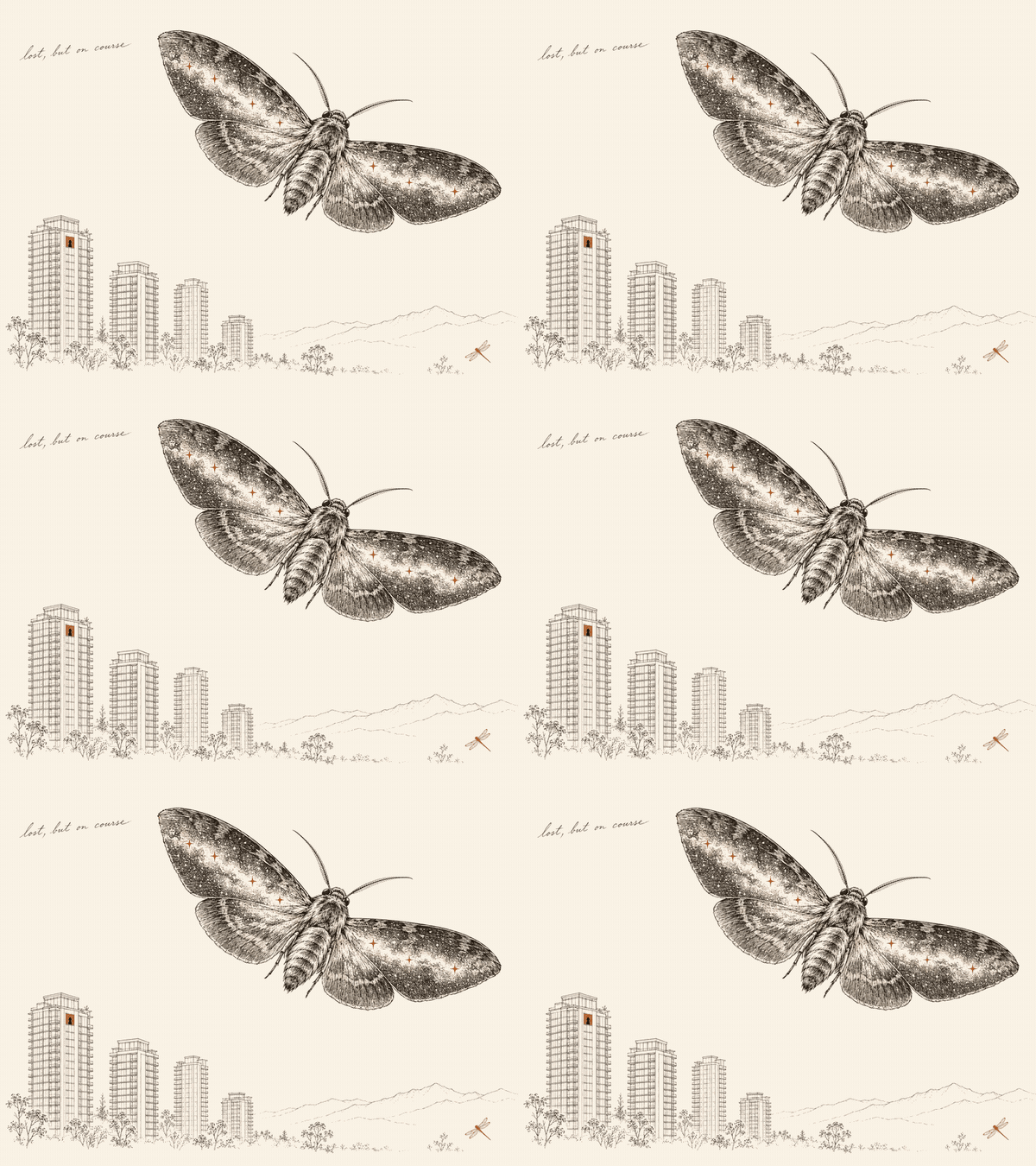
Millions of them were migrating when strong winds blew them off course - straight into Sydney. People were finding swarms of them covering their windows, flying into homes, some were even crawling into their ears at night.
“There’s no chance we’d get any, we’re on the seventeenth floor. They’d have to take the lift,” I said.
I was about to be proven wrong.
The bedroom light was on when I got home, with the window still open. I walked in to put my bag down, and out of the corner of my eye I saw something big and brown on the wall.
As soon as I saw it, it took off.
Hitting the ceiling, then the wall, then the ceiling again, over and over.
Ahhhhh help!
I frantically shut the bedroom door to try and catch it.
So I grabbed an empty jar. And braced myself for the chase.
I jumped onto the bed.
Ran over to the bookcase.
Over to the window, which it didn’t fly out of.
Then, it flew straight into me, hitting me in the forehead.
Ouch!
I was screaming the whole time. It was screaming too. Like it was trying to get somewhere, but couldn’t work out how.
And then suddenly in all the screaming, a deep concern came over me.
It’s scared! I have to save it!
Then, it disappeared.
I searched for about thirty minutes, before deciding that it must have escaped so headed to bed.
The next morning, I opened my eyes and there it was. A big brown beauty resting on my curtains, its wings wrapped to the side like a blanket.
It looks so peaceful.
This time I caught it in the jar, bowed my head in gratitude for it being a good guest, and let it out.
And then it dawned on me. I’d always seen birds flying up here, but never something as ordinary as a moth.
How had it got up here, and where had it been trying to go?
Enjoying this? Get a new story every Thursday.
Subscribe free →The Science
Every year, Bogongs moths fly over 1,000 kilometres, under the night sky to reach cool inland caves.
They climb to heights where the wind is the fastest, so they can ride it and cover ground quickly.
This spring, strong north-westerly winds are thought to have pushed more of them than usual towards the coast and into Sydney. Once, near the city, artificial lights can draw them away from their normal migration route.
They normally head to the Snowy Mountains, which is Australia's highest mountain range. Where theby spend the summer in cool caves and rock crevices that offer shelter from the heat. All without a guide.
But how does a moth find a cave it has never been to before?
In 2025, scientists from Lund University in Sweden set out to answer this very question. They caught Bogong moths partway through their migration and tethered each one inside a round arena, so they could flap their wings and choose a direction without flying away.
First, the researchers blocked out the Earth’s magnetic field, which moths can use to navigate. That way they could test whether the stars alone were enough to guide them.
So, above the moths, they projected a realistic night sky - complete with constellations and the Milky Way.
The Milky Way is the galaxy we live in. We see it as a long pale band, stretching across the night sky. But it’s actually the combined glow of an enormous number of distant stars.
That band creates a recognisable pattern in the sky, and the researchers investigated whether the moths could use that pattern to find their direction.
Under that projected night sky, the moths flew south towards the mountains, just as they would on a real spring migration. Then they turned the sky halfway round, the moths turned around with it. And when they jumbled the stars into a random arrangement, the moths lost their sense of direction completely.
They also measured activity in the moths’ brains while rotating the sky above them. The researchers discovered that certain brain cells responded to the arrangement of stars, becoming most active when the moth was facing south.
Some of those cells also responded to features resembling the Milky Way’s long band of light. Scientists haven’t yet established which features the moths rely on, but the results certainly show that they use the night sky as a compass.
And the most fascinating insight here is when the experiment was reversed.
This time they hid the stars but kept the Earth’s magnetic field on, but the moths could still maintain their direction.
This suggests they are born with an instinctive sense of which direction to travel in, even though they have never made the journey before.
Which made the Bogong moth on my wall all the more extraordinary.
It had been navigating the stars, to get to a place it had never seen, when it had seen my light and took a wrong turn.
Where It Shows Up
When you cook without a recipe, and although you don’t know exactly how it will turn out, you taste it as you go and know when it’s right.
When you’re scrolling through other people’s lives. Someone else’s highlight reel becomes what you’re steered by, and you lose track of where you were heading.
When you’re in your pyjamas and almost say no to an invitation, but something makes you grab your keys and go anyway. A few months later, it’s the reason you have friends you can’t imagine life without.
The Subtextt
Beneath the feeling of a panicked moth is the reminder that you can be lost and still know your way.
That night, a creature heading for a place it had never seen before ended up in the wrong room, with its sense of direction still in place.
Most of our lives run on the idea that we need to know exactly where each decision, each move, each relationship will take us.
But a destination is simply an outcome we hope for. A direction is knowing what matters to us and choosing how to act on it, wherever it leads.
We can therefore know which way to go, long before we know where we’ll end up.
All we have to do is follow the stars.