

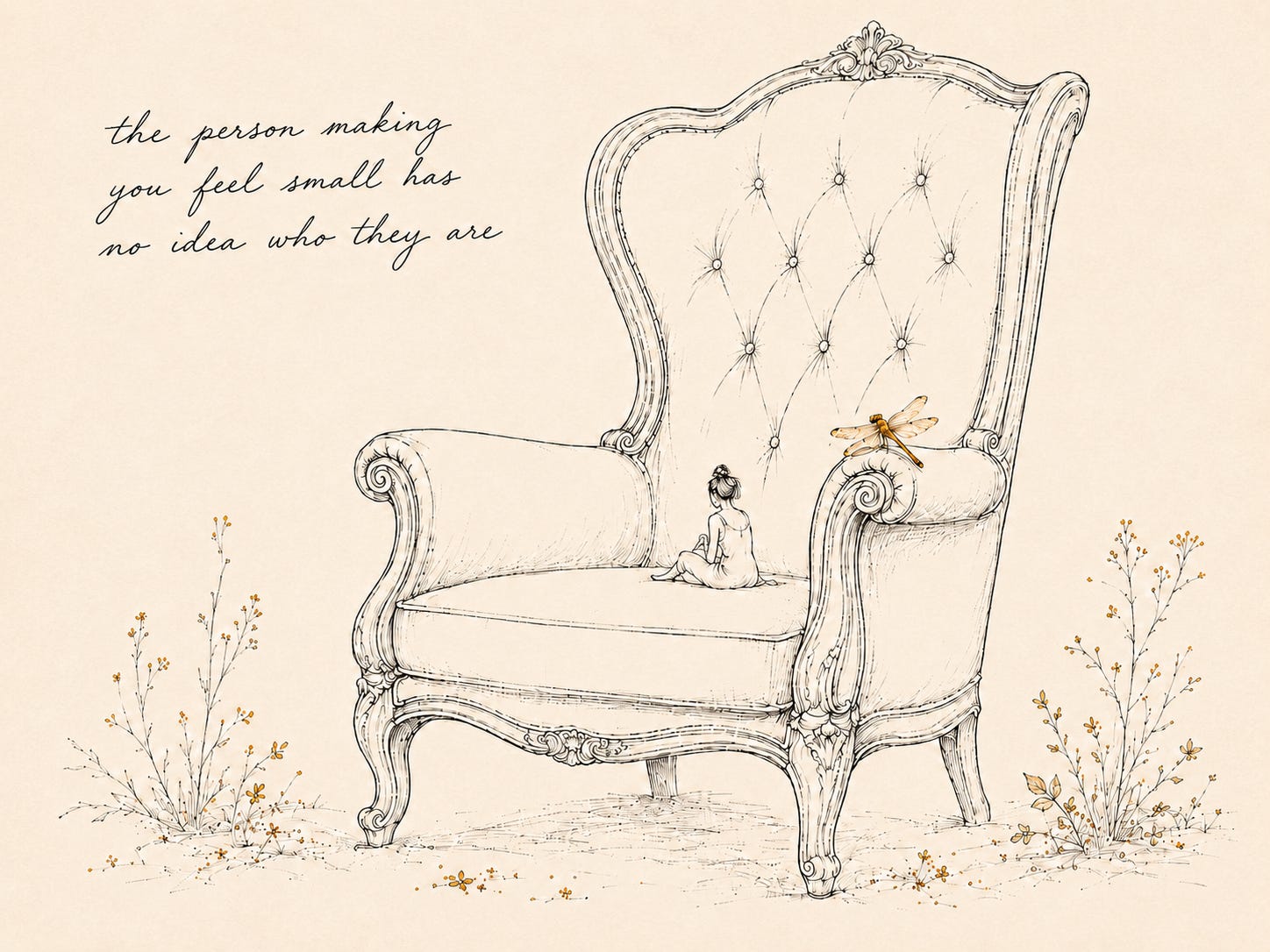
The Idea
This happened a long time ago, but I remember it like it was yesterday.
It’s 3am and I’m awake.
Anxiety has pulled me out of sleep again. I’m lying in the dark going over and over what I’m going to say tomorrow.
Just stay calm. Say the right things. Don’t answer back. It’ll be fine.
I’ve been saying that to myself for a year now.
He appeared to have it all. Charismatic, visionary, the kind of person who walked into a room and immediately owned it. Everyone admired him. I admired him, it’s why I’d joined his team, and I trusted he would open doors for me.
If only I’d known it would turn out like this. His fists slamming the table. I couldn’t think straight. Frozen. Told I was wrong, told I didn't listen, told that I was too special to behave like this.
Did that just cross a line?
I was so consumed by anxiety that I couldn’t pick myself up. I stopped speaking up at work and at home too.
The Niki who always spoke her mind was on the floor, along with her confidence.
For a long time I thought the whole thing was my fault. But I was wrong.
Everything changed when I stopped asking what was wrong with me, and started wondering what had happened to him.
Before I go further, I want to say this clearly. What I've just described is not ok. If you are lying awake right now in a version of this situation — please speak to a friend, a professional, or a helpline.
I will always wish I had done that sooner.
The Science
Picture the moment as it unfolded.
I’ve said something. Maybe given a different perspective that didn’t fit with his. You know the kind of thing that gets shared in meetings all the time.
But he reacted immediately. I saw him tighten up, and then the disproportionate anger came in fast. His fists came down on the table, again, and again. His voice filled the whole room - direct, accusatory, threatening.
I did what I had done so many times before, I went small and said nothing.
Please God, let it be over soon.
He tells me to leave, so I get out of there quickly.
He’s alone now.
He picks up his phone almost immediately and calls someone who will listen. As he speaks, he needs to hear that he was right. That what he said was reasonable and that I must be the problem.
There's something in science that helps explain this moment.
Every human brain has a system whose only job is to keep you alive. It scans your environment constantly looking for anything that might be a threat. When it detects danger, it moves fast, flooding the body with stress hormones. This shuts down rational thought, and takes over completely.
Neuroscientists call this an amygdala hijack — the moment the brain’s threat detection system overrides rational thought entirely. It happens in seconds, before the conscious mind has caught up. And it looks, from the outside, exactly like anger.
In most people, another part of the brain will step in quickly to reason clearly, find empathy, and offer perspective. It will say: this is just a meeting, you’re safe, stand down.
But when someone has spent years, maybe a lifetime, learning that their position in the room is the thing keeping them safe the threat response runs the show.
And what comes out isn’t leadership. Let me repeat that, what comes out isn’t leadership. It’s someone who was never taught that a difference of opinion doesn’t mean danger.
The phone call ends. The feeling settles in him, for now.
He doesn’t know that nothing has actually been resolved. He doesn’t know he’ll need to make the same call to his friend tomorrow, and the next day, and the day after that.
He doesn’t even know that the anger in the room was his fear dressed up as authority.
He just knows he needed to hear that he was right.
Where It Shows Up
You know this person.
It might be a boss who takes credit for your ideas at the same time as dismissing them. Or a partner who needs to say the last word. Or a friend who leaves you minimised in every conversation and you can’t quite put your finger on why.
What makes this so hard to see in the moment is that these people are often extraordinarily compelling on the surface. Charming, decisive, magnetic.
But the gap between the public version and the private one is precisely the point. They perform confidence. It’s how their fear stays hidden, even from themselves.
What they do to you in those moments has nothing to do with who you are, because it is actually about them.
The Subtextt
Beneath the feeling of being shut down is someone else’s fear looking for a place to go.
There’s a principle in physics that says energy cannot be created or destroyed — it can only move from one place to another. His anxiety became my 3am. His fear became my self-doubt. His instability became my silence.
I didn’t create any of that. I just absorbed it.
He taught me something I really needed to learn: finding humility instead of bitterness in an unbearable situation — because that was the only part of it that was mine to choose.
Humility doesn’t excuse what happened, but it helped in understanding that the energy being transferred to me wasn’t mine to hold onto. And just like that, after years of pain, I let it go.
I didn’t know that while I was lying awake at 3am, rehearsing my survival. But I know it now.
And if you’re lying awake right now rehearsing yours — I want you to know it too.
Someone else’s inability to regulate themselves is not evidence that you are too much, too wrong, or too difficult.
It is evidence that their fear needed somewhere to go.
If you can get to this place, gratitude and freedom can begin.
This is a really powerful story and I applaud your courage to sharing it. It is also really important for those who have suffered similar situations to now have the science and context behind what they are experiencing and the tools to deal with this type of situation. I wished I had known this was what was happening to me in similar situations when I was younger and less prepared to handle it.
This resonates with me so strongly. I have been in this kind of situation and have absorbed it in just the same way. There is so much power in understanding the reason behind such a reaction. I feel that it’s also a great reminder that very few situations, if any, require us to immediately react. It prevents a lot of pain for us and those around us. Thank you for writing this <3