
This is a guide for when you’re in the middle of something hard and you don’t yet know what it means.
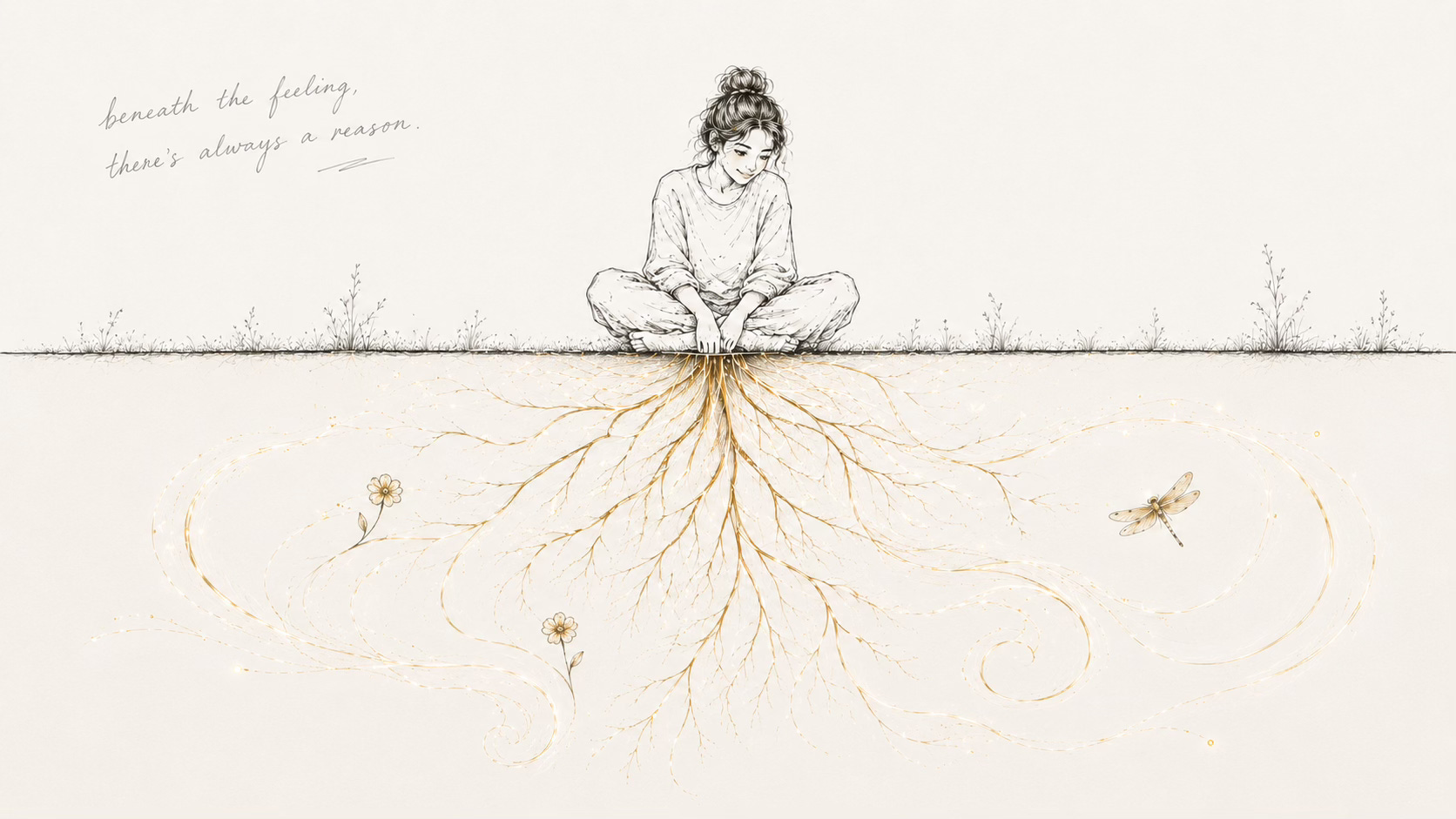
Every difficult feeling has something underneath it.
This page helps you find it in three steps.
By the end, you’ll have one sentence that changes how you see what you’re going through.
Do it at your own pace, and come back to this page whenever you need to.
Step 1: Surrender
What to do
Go outside and walk in nature. If you can, be around animals.
Why this works
Your body responds to difficult feelings the same way it responds to physical danger - it tenses up. In that state, nothing can get through.
Japanese researchers found that just twenty minutes in a natural environment reduces cortisol, which is your primary stress hormone, and brings your nervous system out of protection mode. Nature is one of the fastest ways to make your body feel safe again. And your body needs to feel safe before it will let any insight in.
When you walk in nature you are literally thinking with something larger than yourself.
What to expect
You won’t feel better immediately, but you will feel less like you’re fighting. The problem will start to feel less like everything and more like one thing. That shift is what you’re looking for.
When you’re ready to move on
When your shoulders have dropped, and you've stopped rehearsing the same thought on repeat. That's when you move to Step 2.
Step 2: Get it out - on the page
What to do
Open a journal or notebook. Write whatever comes into your head. Don't stop. Don't try to make it make sense. Just let it come out exactly as it arrives. It will be messy, contradictory, half formed. Keep going until you feel empty.
Why this works
Psychologist James Pennebaker spent decades researching what happens when people write honestly about difficult experiences. He found that expressive writing — unfiltered, uncensored, without an audience — measurably reduces stress hormones, helps the immune system recover, and allows the brain to begin processing what it's been carrying.
The act of moving a thought from inside you to outside you changes your relationship with it. It stops being something you are and starts being something you can look at.
What to expect
Try to stay in the present moment. Don’t focus on what happened last week or what might happen next month. Just what is happening right now, in this feeling, in your body. Time has a way of making difficulty feel permanent, but the past isn’t fixed and the future isn’t already written. The only moment that is real is the one you’re in right now.
Step 2b: Get it out - say it
What to do
Find someone you trust and speak it out. Not to get advice.
Why this works
When a feeling moves from thought to word to voice it becomes less enormous. When you say something out loud to someone who cares, you know you’re heard and that makes the feeling smaller. Which is why a good conversation with the right person can feel like physically putting something down.
When you’re ready to move on
When you've said it out loud to someone you trust and felt the weight shift slightly. Let it be unresolved. It isn’t meant to make sense while you’re in it. Move to Step 3.
Step 3: Stay open
What to do
Keep a small notebook by your bed or a note on your phone. Not to write in every day, but to just catch things when they arrive. It could be a sentence on the commute home, or a thought in the supermarket. Wherever it happens, it’s a moment of clarity in the middle of something ordinary. Write it down. Don’t analyse it. Just keep it.
Why this works
Most guides promise a breakthrough. A moment where everything clicks and you emerge on the other side changed. Let me tell you, that’s not how it works.
Your brain doesn’t process difficult experiences in one sitting, it works on them slowly, in the background, over time. Neuroscientists call this consolidation, which is the process by which the brain organises and integrates new experience, often during rest and sleep rather than during conscious effort.
The insight (or subtextt) you’re looking for isn’t hiding somewhere waiting to be found. It’s coming together while you get on with your life.
What to expect
The pieces of you that were shaken loose don’t land all at once. They settle gradually, in their own time, in their own order. And when they do land, they won’t land in the same place they came from. You will be different because you went through something and kept going.
You may not be through it yet. That’s ok, it’s the journey. Keep returning to Step 1 whenever the feeling builds again. Keep writing. Keep speaking it out. Keep catching the ah-hah moments when they arrive uninvited.
When you’re ready
When something that confused you begins to make sense. You’ll know because small things will start to click together, like lego bricks.
The Subtextt
This is what you’ve been working towards.
Complete this sentence: Beneath the feeling of ................., I now understand that .................
Example: Beneath the feeling of failure, I now understand that I didn’t lose my identity when I lost my job. I just lost the thing I’d been mistaking for it.
Write it down. Keep it. Come back to it.
It’s yours.